

“By nature, we’re an optimistic country. But I understand that right now it’s hard to be positive.”
Anthony Albanese, Address to the Nation, 1 April 2026
Australia is a great country to live in - for most people. And because it is a great country, we tend to sweat the small stuff. By most metrics, we are, on average, a healthy, happy, and prosperous nation. So this isn’t a post about ‘Why Australia sucks’. But it is about how some of the small stuff isn’t that small any more.
The upcoming federal budget on 12 May is possibly the most anticipated federal budget of the 21st century. Yes, there was the global financial crisis and the pandemic, but these crises were treated as extraordinary events to be overcome so Australia could return to normal. In 2026, Australians don’t seem to want normal. They think normal has failed them.
The prime minister’s address to the nation on 1 April 2026 confirmed in a lot of people’s minds that our governing class is directionless. For me it brought to mind Jimmy Carter’s 1979 address to the nation - the ‘Malaise’ speech - though he never used that word.
It’s worth quoting the relevant part of Carter’s speech in full:
I want to talk to you right now about a fundamental threat to American democracy.
I do not mean our political and civil liberties. They will endure. And I do not refer to the outward strength of America, a nation that is at peace tonight everywhere in the world, with unmatched economic power and military might.
The threat is nearly invisible in ordinary ways. It is a crisis of confidence. It is a crisis that strikes at the very heart and soul and spirit of our national will. We can see this crisis in the growing doubt about the meaning of our own lives and in the loss of a unity of purpose for our nation.
The erosion of our confidence in the future is threatening to destroy the social and the political fabric of America.
The confidence that we have always had as a people is not simply some romantic dream or a proverb in a dusty book that we read just on the Fourth of July.
It is the idea which founded our nation and has guided our development as a people. Confidence in the future has supported everything else -- public institutions and private enterprise, our own families, and the very Constitution of the United States. Confidence has defined our course and has served as a link between generations. We’ve always believed in something called progress. We’ve always had a faith that the days of our children would be better than our own.
Our people are losing that faith, not only in government itself but in the ability as citizens to serve as the ultimate rulers and shapers of our democracy. As a people we know our past and we are proud of it. Our progress has been part of the living history of America, even the world. We always believed that we were part of a great movement of humanity itself called democracy, involved in the search for freedom, and that belief has always strengthened us in our purpose. But just as we are losing our confidence in the future, we are also beginning to close the door on our past.
He might have been talking about today.
Below are some charts I’ve picked up in the news, from think tanks, government bodies, and other research institutes. Now I’m dumping them here. Taken together they don’t paint a great picture. Australia’s been through worse, but rarely have we been as aimless. In all facets of life, we are muddling through. I’ve had a crack at explaining why. This post, however, is more of a quantitative whinge.
We’re pessimistic about the future, and increasingly negative about the past
1. Australians expect life to get worse over the next year
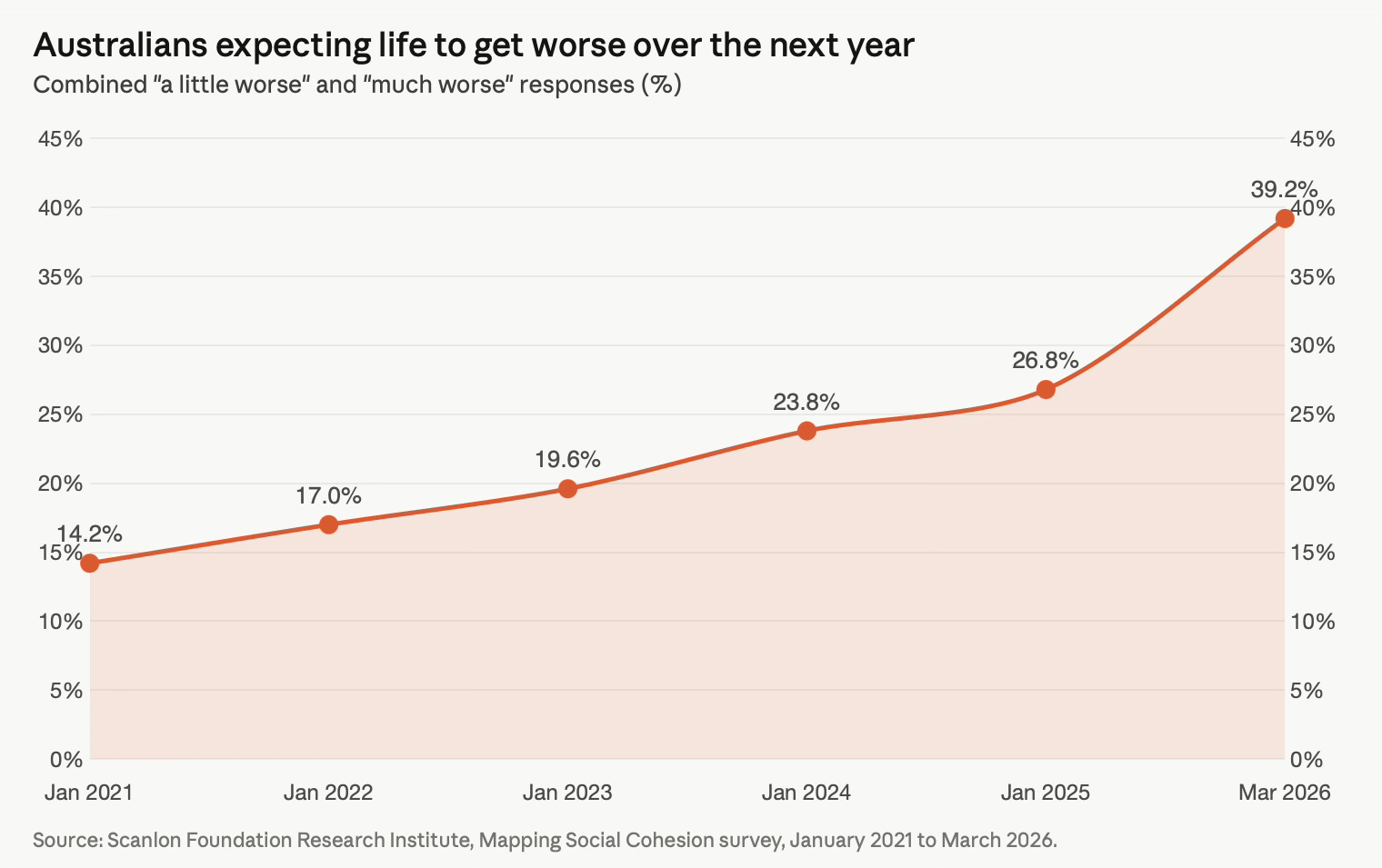
Source: Professor Nicholas Biddle and Professor Matthew Gray, Holding together, Just: Wellbeing, Economic Strain, and Democratic Resilience in Australia, Australian National University, March 2026
2. They think they’re heading in the wrong direction
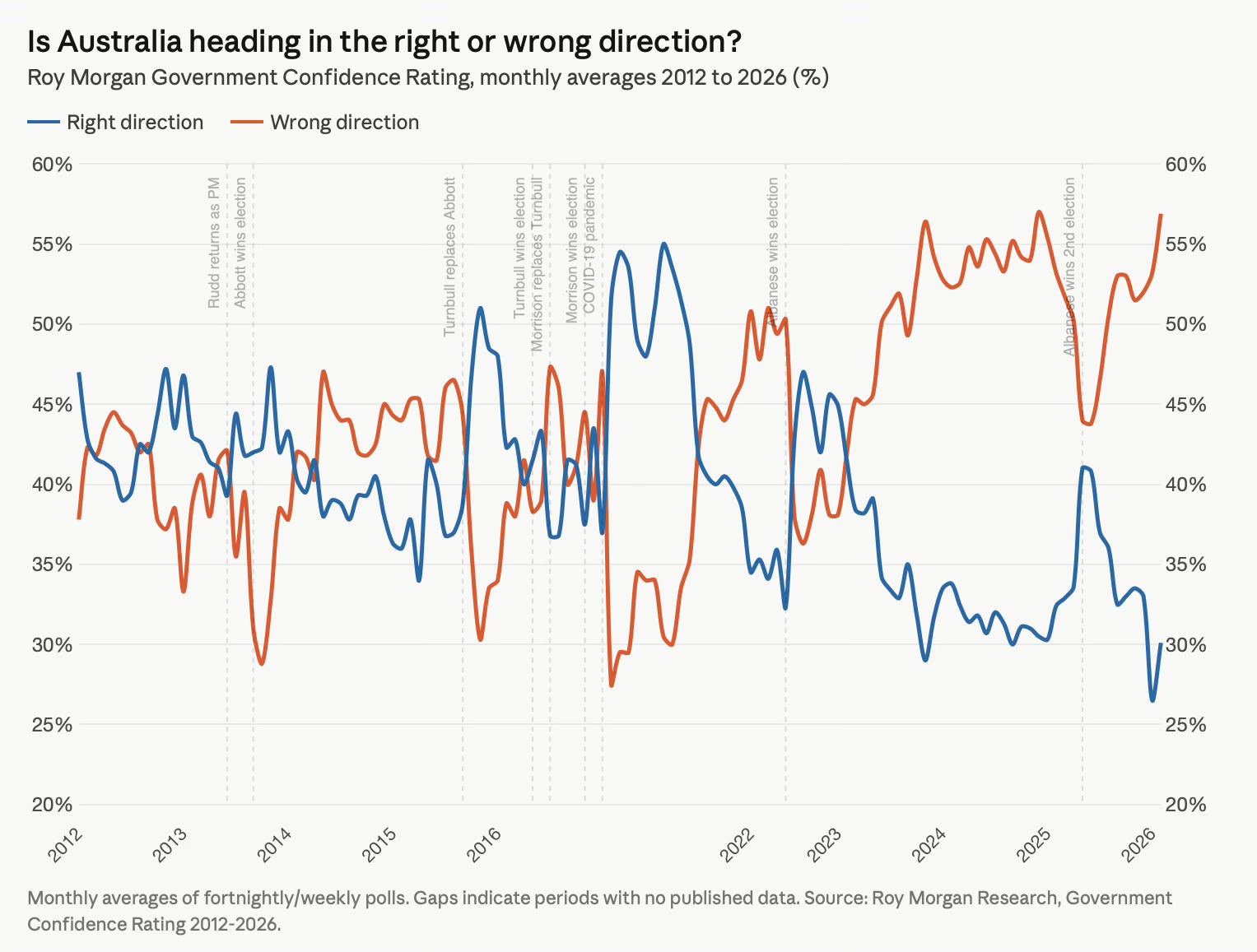
Source: Roy Morgan Research, Federal Voting – Government Confidence Rating (2012-2025) (note that there are long gaps in the data between 2016 and 2019)
3. They now think the last fifty years have been terrible.
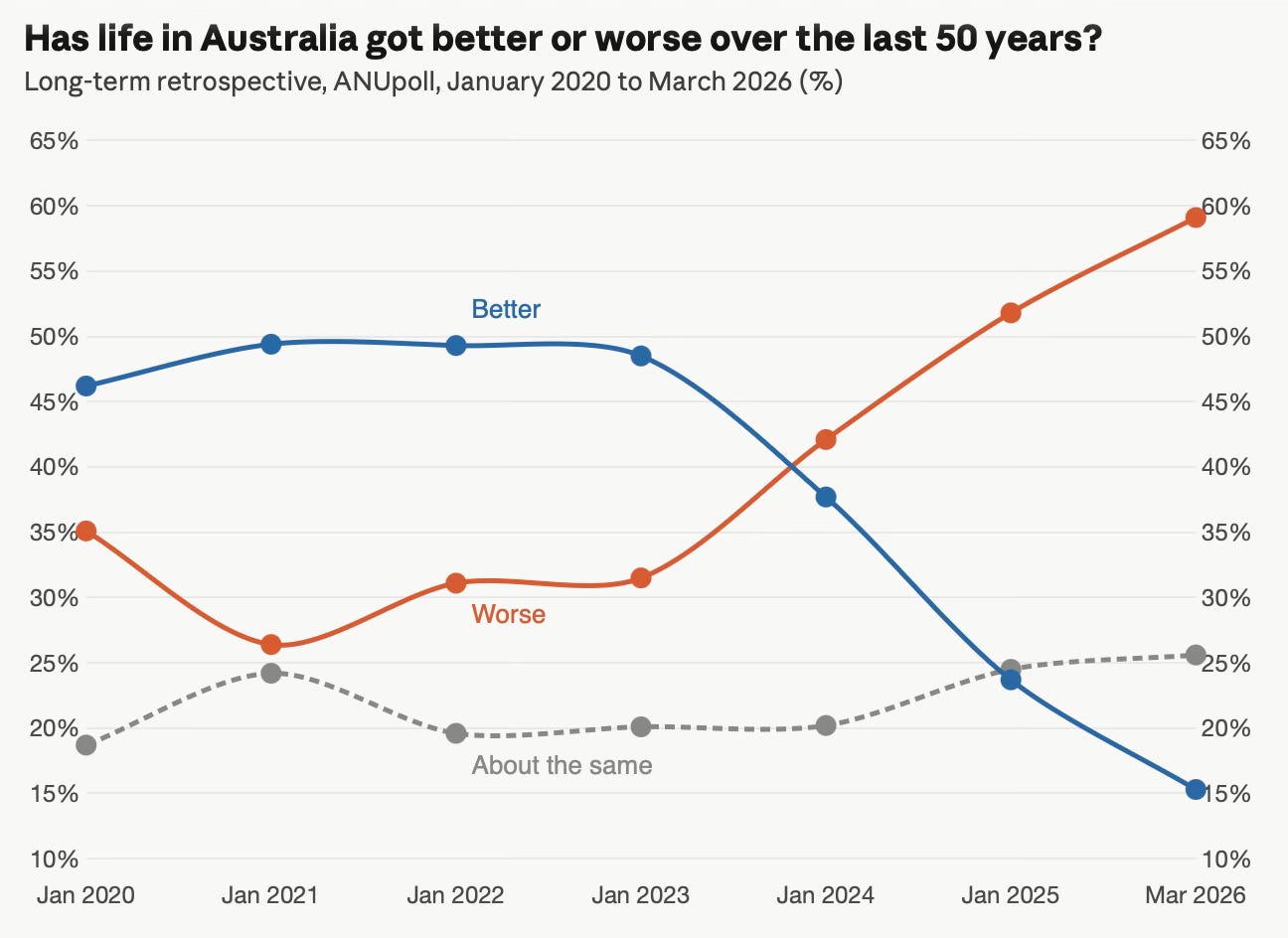
Source: Professor Nicholas Biddle and Professor Matthew Gray, Holding together, Just: Wellbeing, Economic Strain, and Democratic Resilience in Australia, Australian National University, March 2026
LIVING STANDARDS ARE STAGNATING…
4. Real wages are taking a beating from inflation
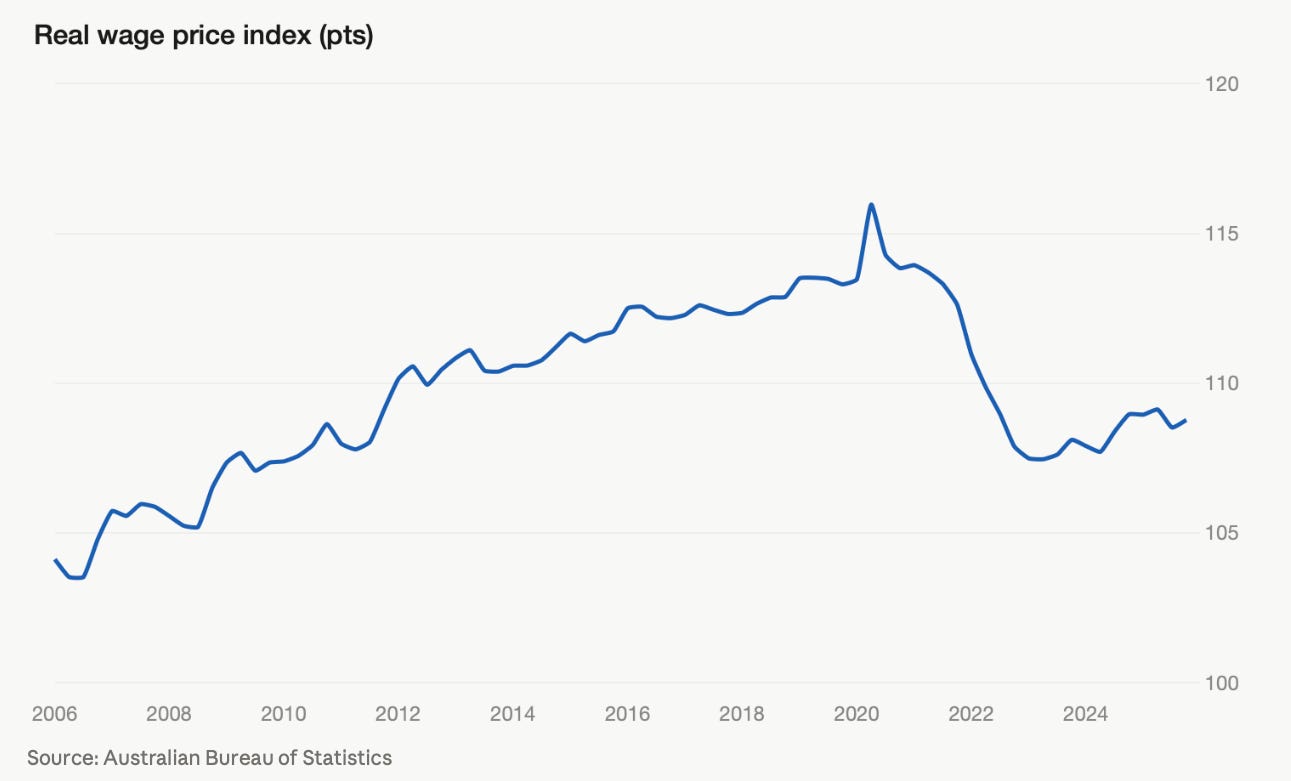
Source: Australian Bureau of Statistics, Wage Price Index, Australia, Consumer Price Index, Australia. Real WPI calculated by deflating WPI by CPI, with 2002=100
5. Growth in disposable income is falling behind comparable countries
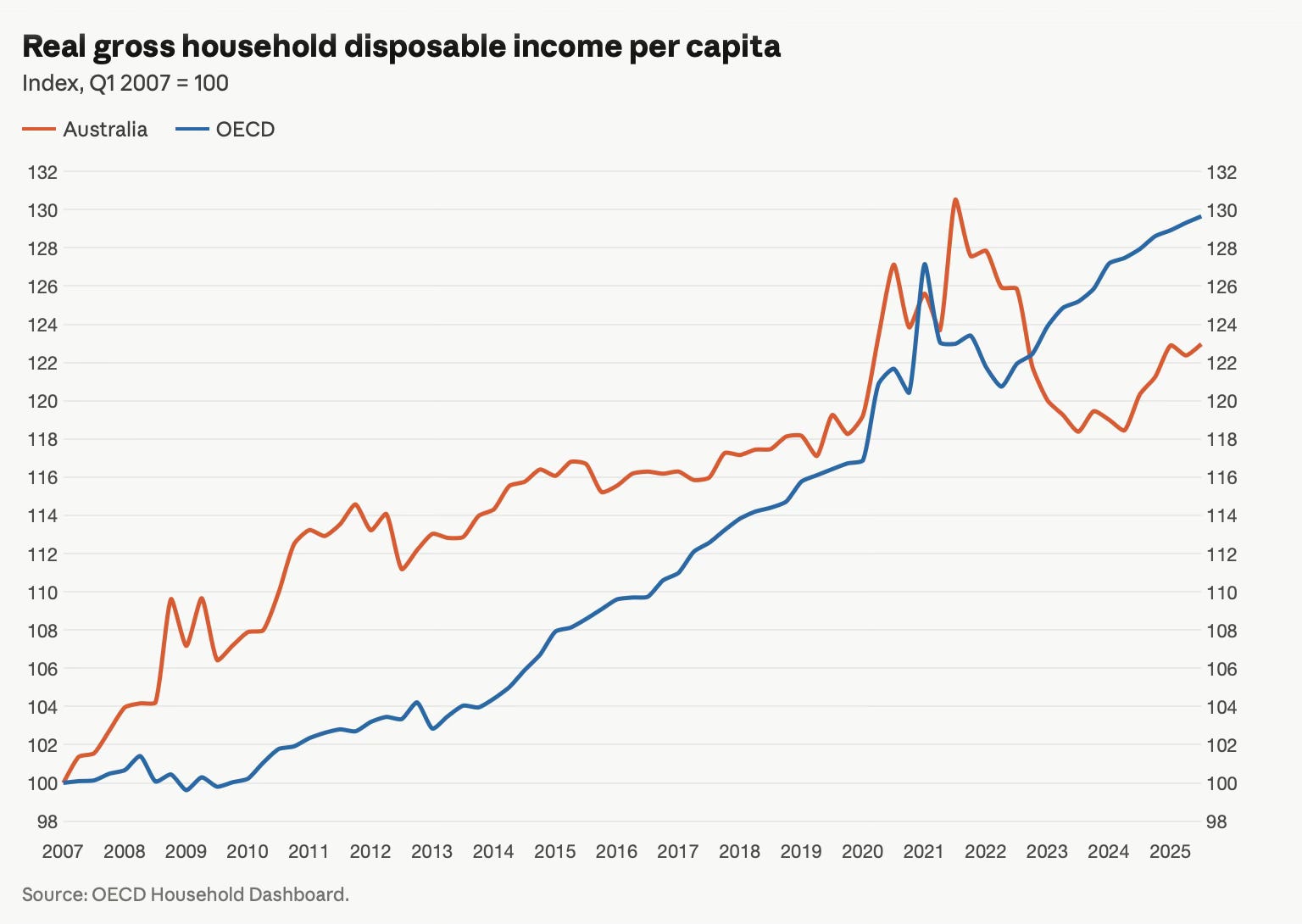
Source: I’ve updated the chart from Michael Read’s ‘Australia’s fall in disposable income is the worst in the world’, Australian Financial Review, 30 August 2024, using OECD Household Dashboard
…AND WE’RE NOT DOING MUCH ABOUT IT
6. Productivity is the lowest it’s been in sixty years - and probably longer than that.
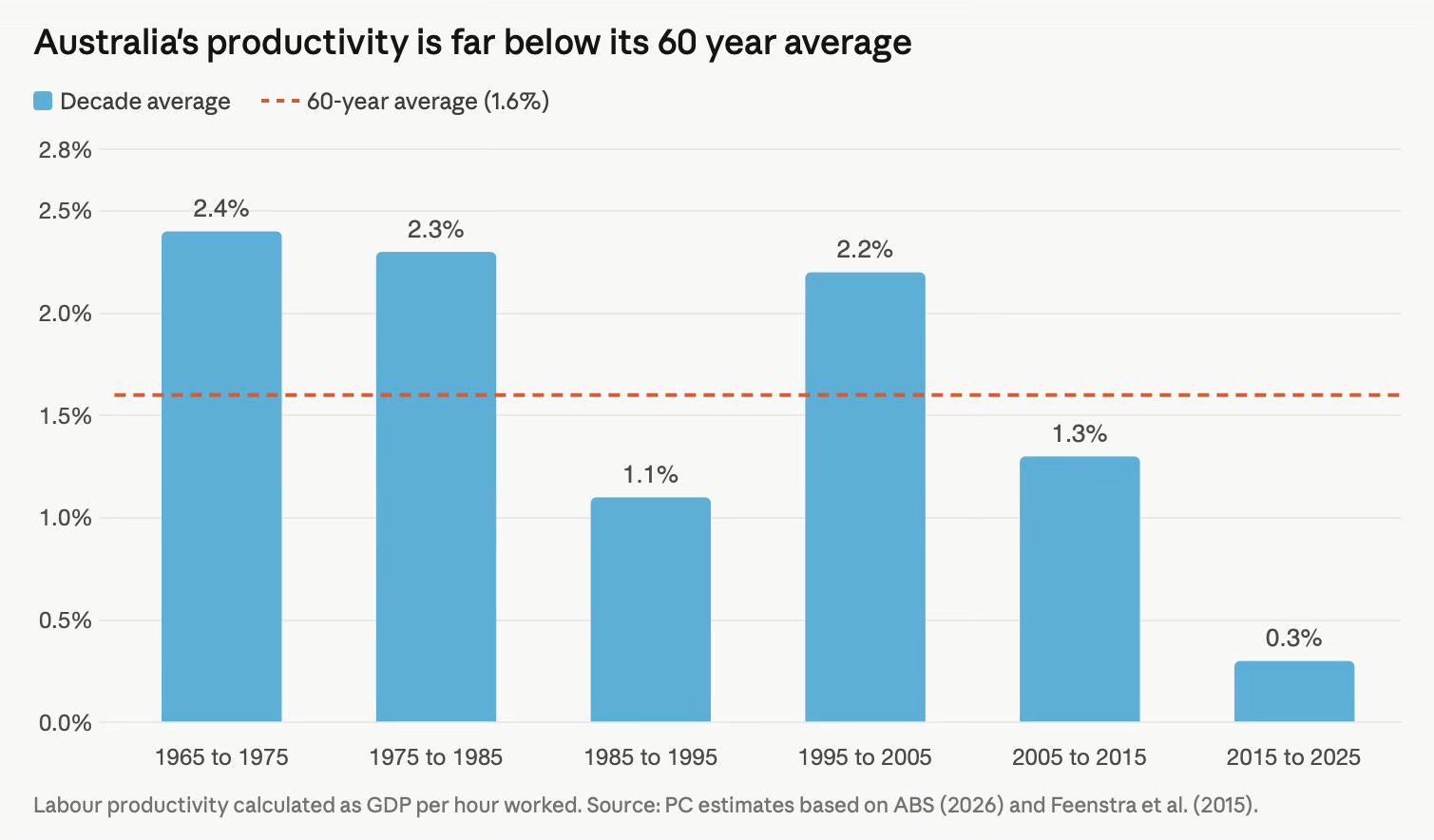
Source: Productivity Commission, Quarterly productivity bulletin, March 2026
7. That’s a problem given almost all wage increases since federation have come from productivity growth
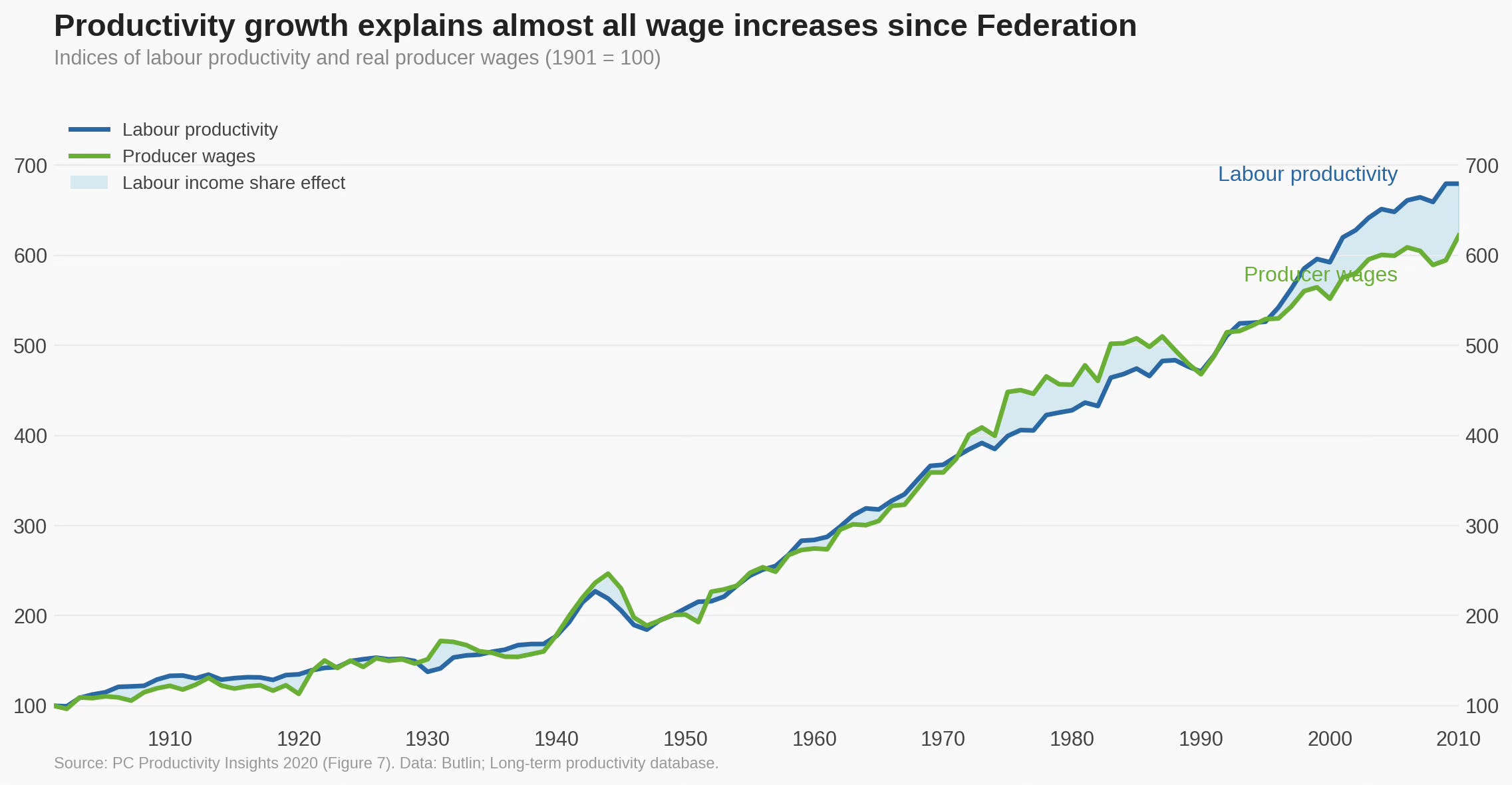
Source: Productivity Commission, Australia’s long term productivity performance, Productivity Insights, No.3, 2020
8. Private investment as a proportion of the economy is at historic lows
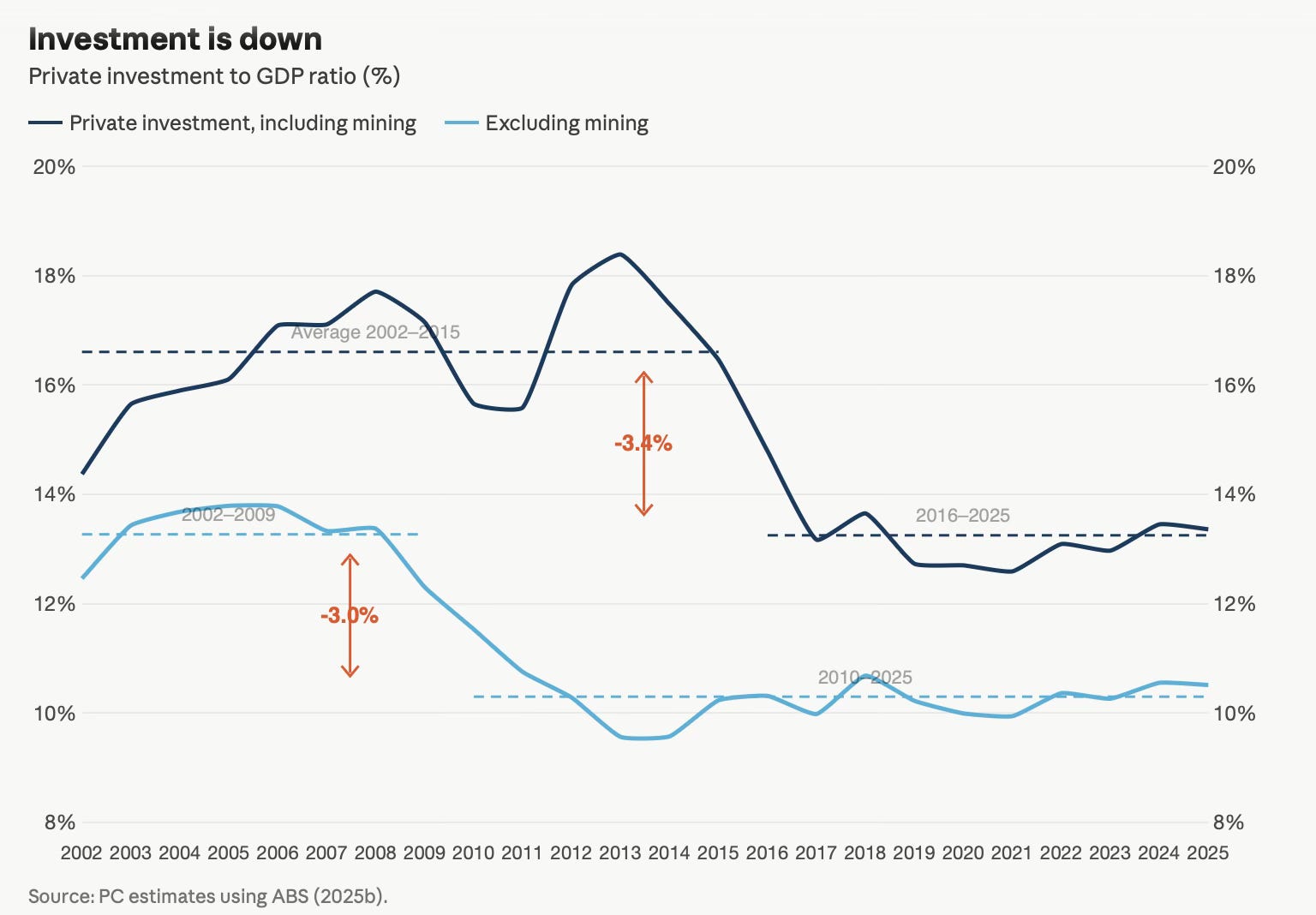
Source: Productivity Commission, Creating a more dynamic and resilient economy, Inquiry Report, 2025
9. And it’s harder to do business in Australia
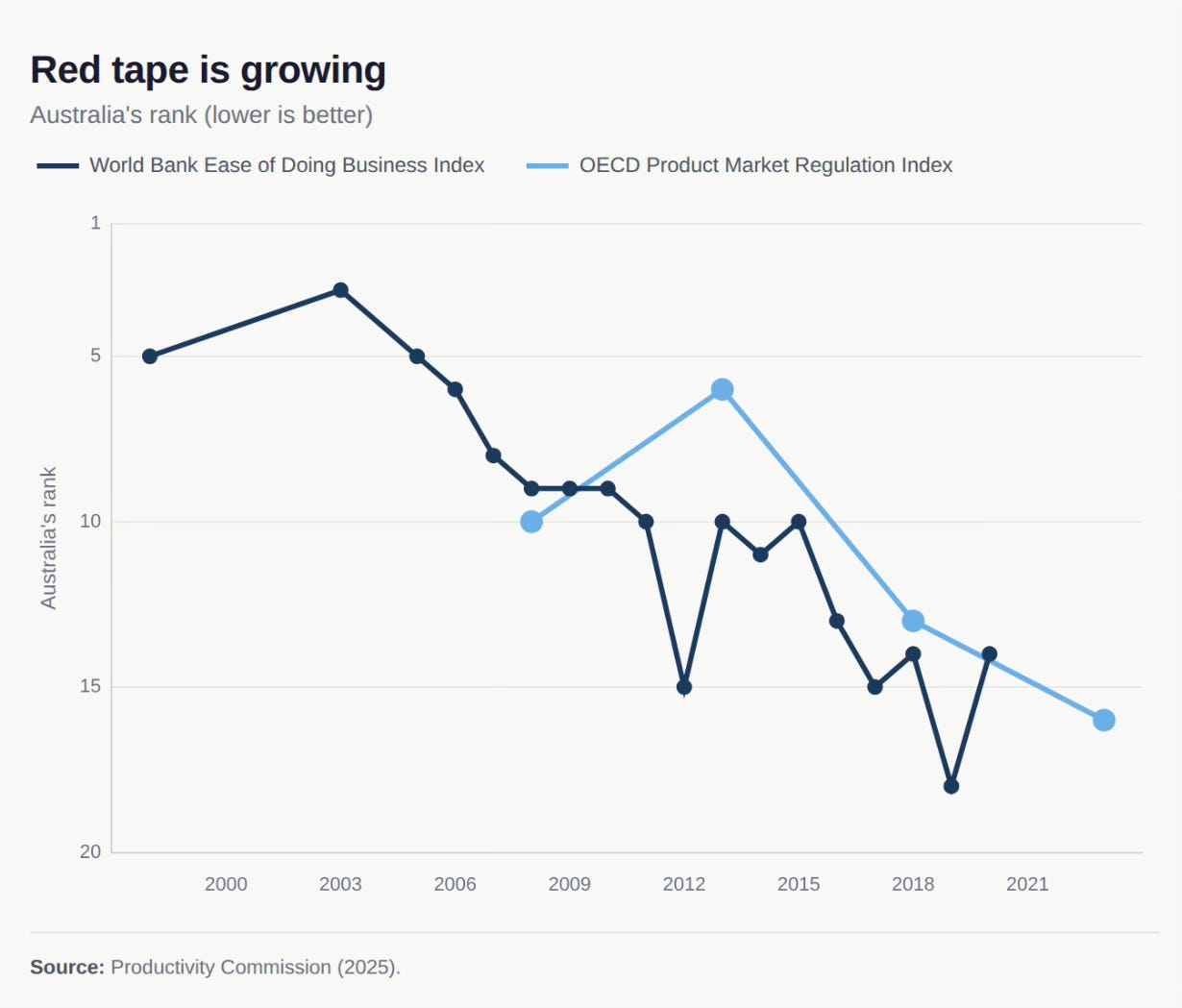
Source: Productivity Commission, Creating a more dynamic and resilient economy, Inquiry Report, 2025
It’s difficult for a low-productivity economy to pay off debt
10. And Australia has a lot of debt
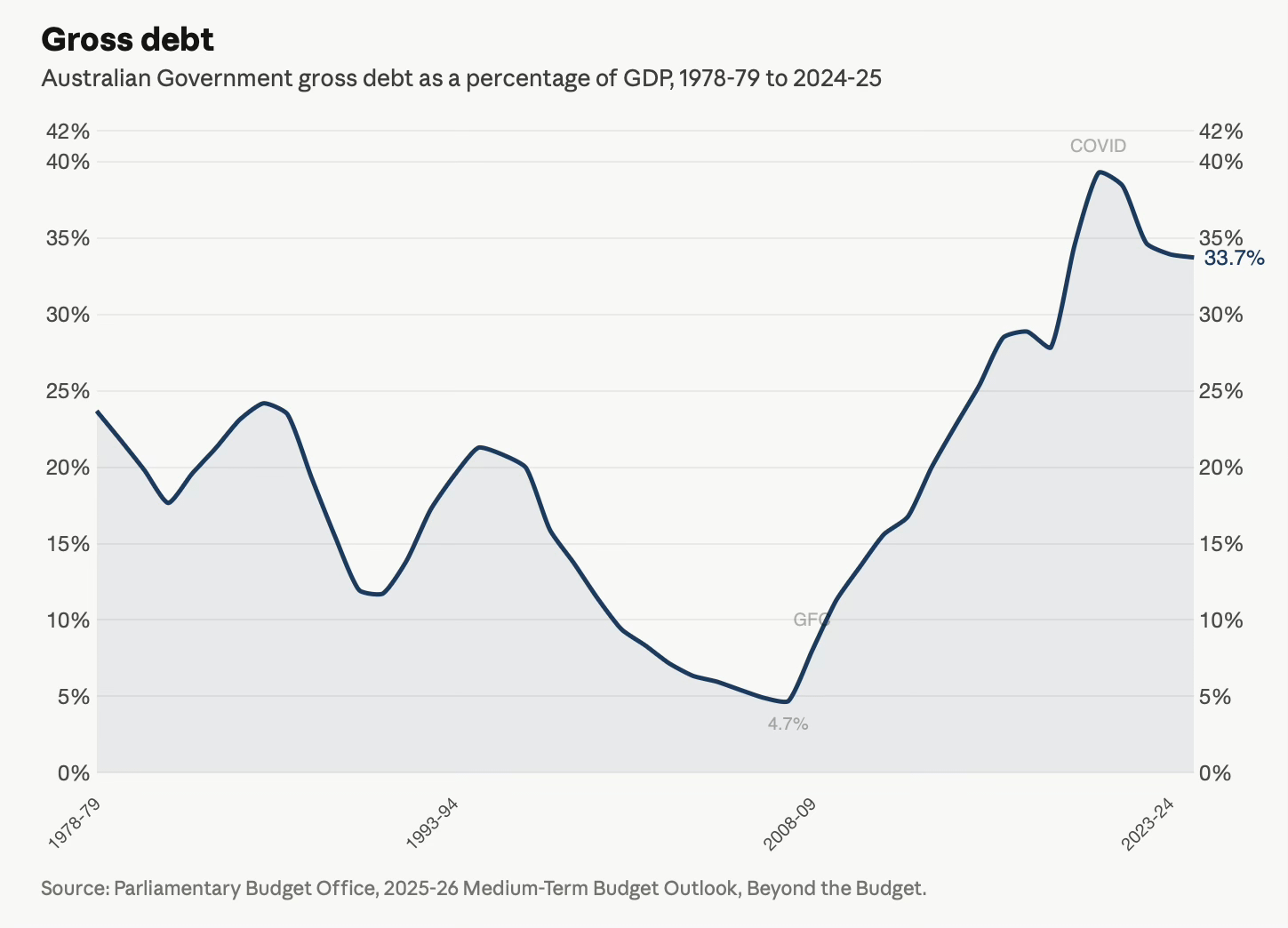
Source: Parliamentary Budget Office, 2025-26 Medium-Term Budget Outlook: Beyond the Budget, September 2025
11. We’re not paying it off if we can’t be more productive
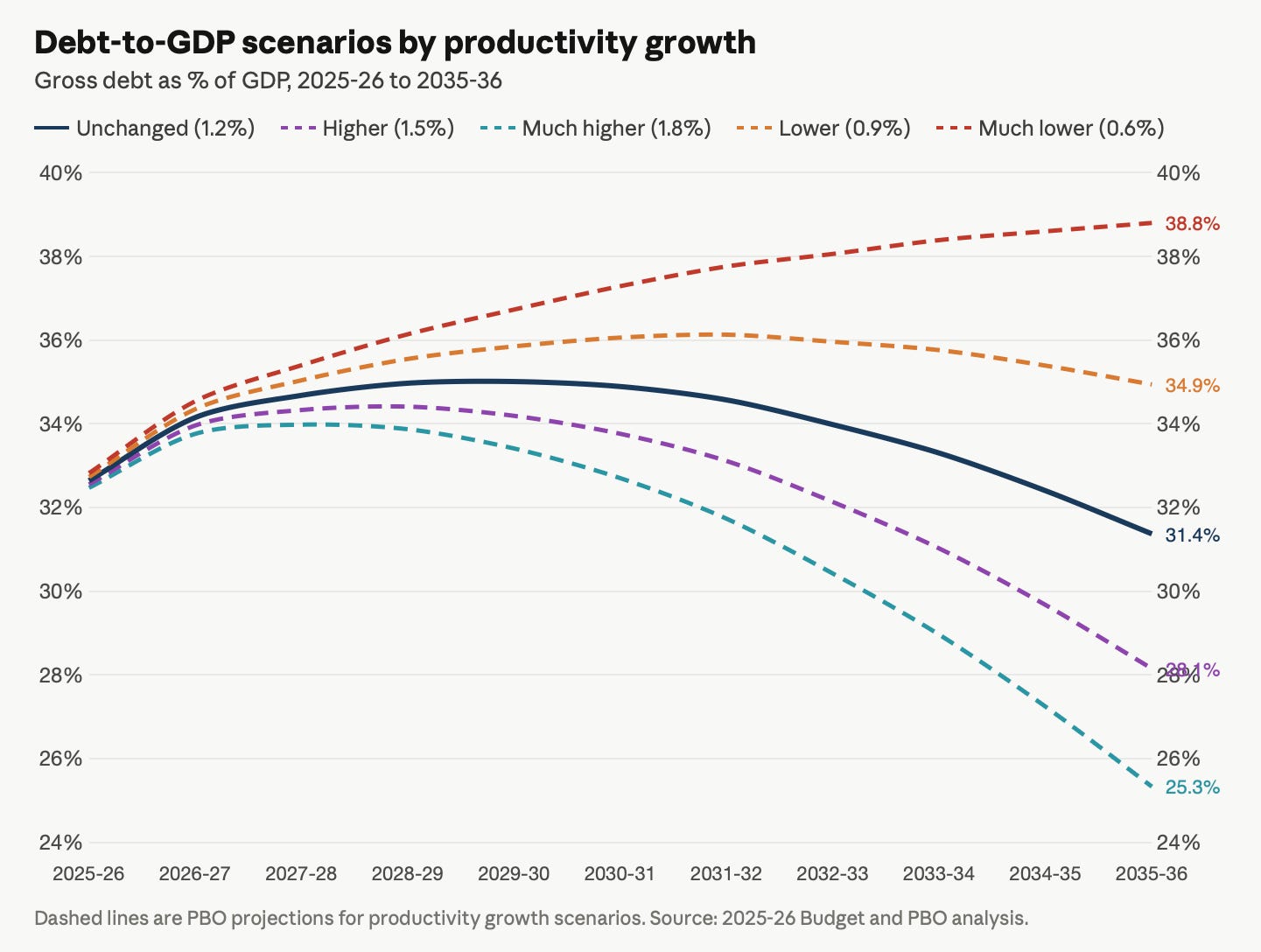
Source: Parliamentary Budget Office, 2025-26 Medium-Term Budget Outlook: Beyond the Budget, September 2025
12. In fact, without bracket creep, we’re not paying it off
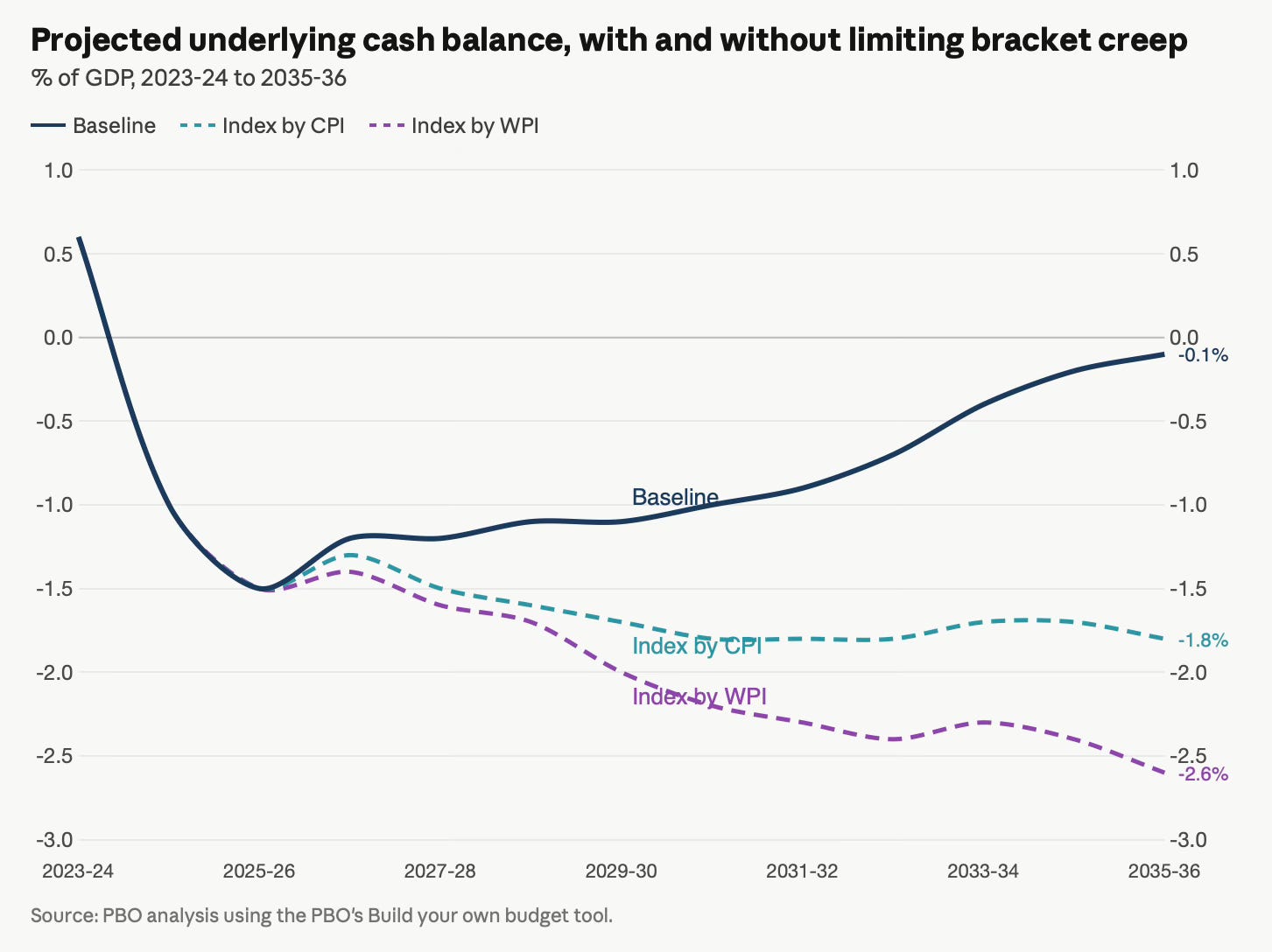
Source: Parliamentary Budget Office, 2025-26 Medium-Term Budget Outlook: Beyond the Budget, September 2025
Australia has big spending pressures
13. And one in particular…
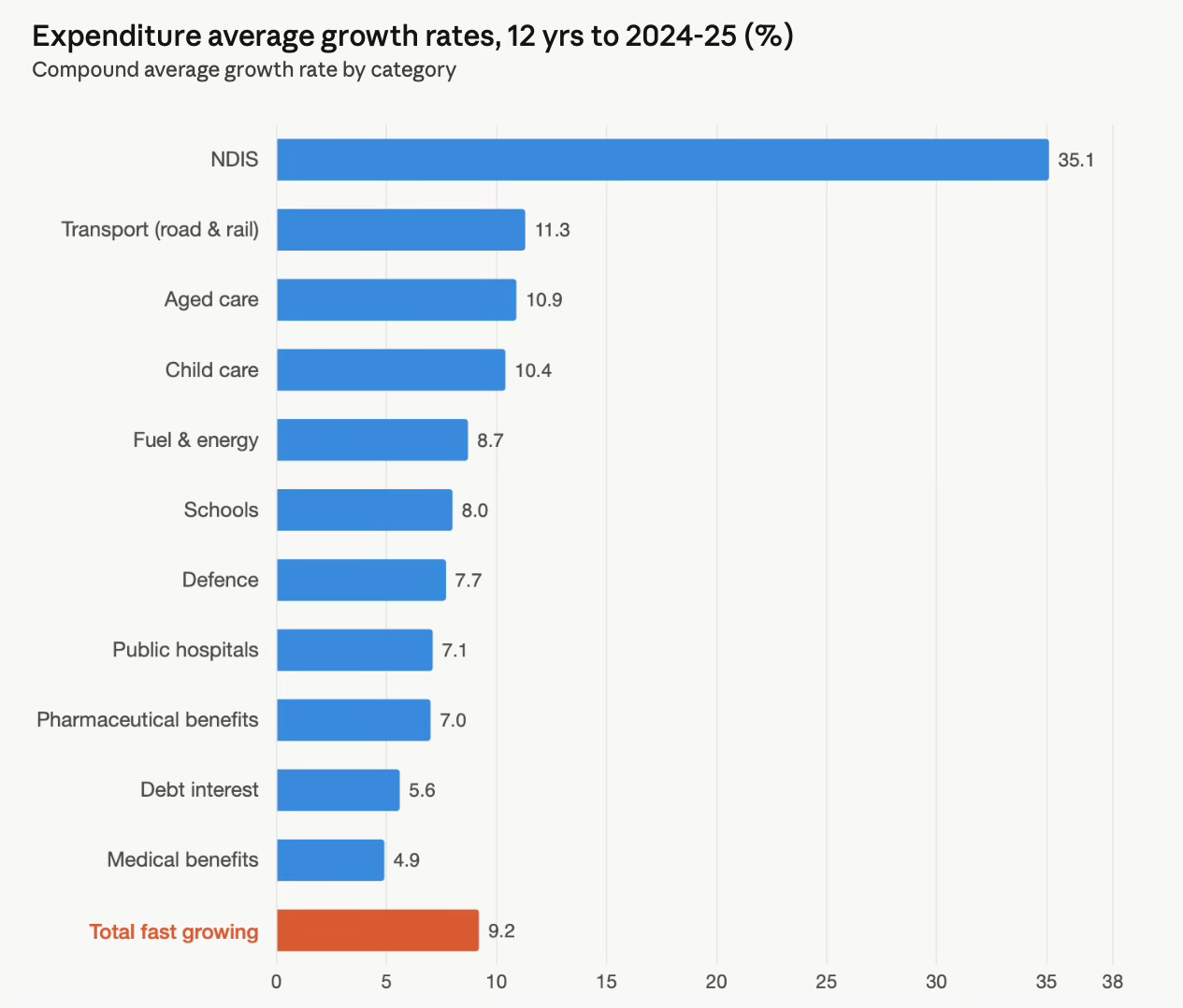
Source: Robert Carling, Leviathan on the Rampage, Centre of Independent Studies, July 23 2025
14. Over the long term, health will be the biggest spending pressure in the budget. But this isn’t just a story about an ageing population. Most of the projected increase comes from non-demographic factors, including policy decisions and rising demand for health services more generally.
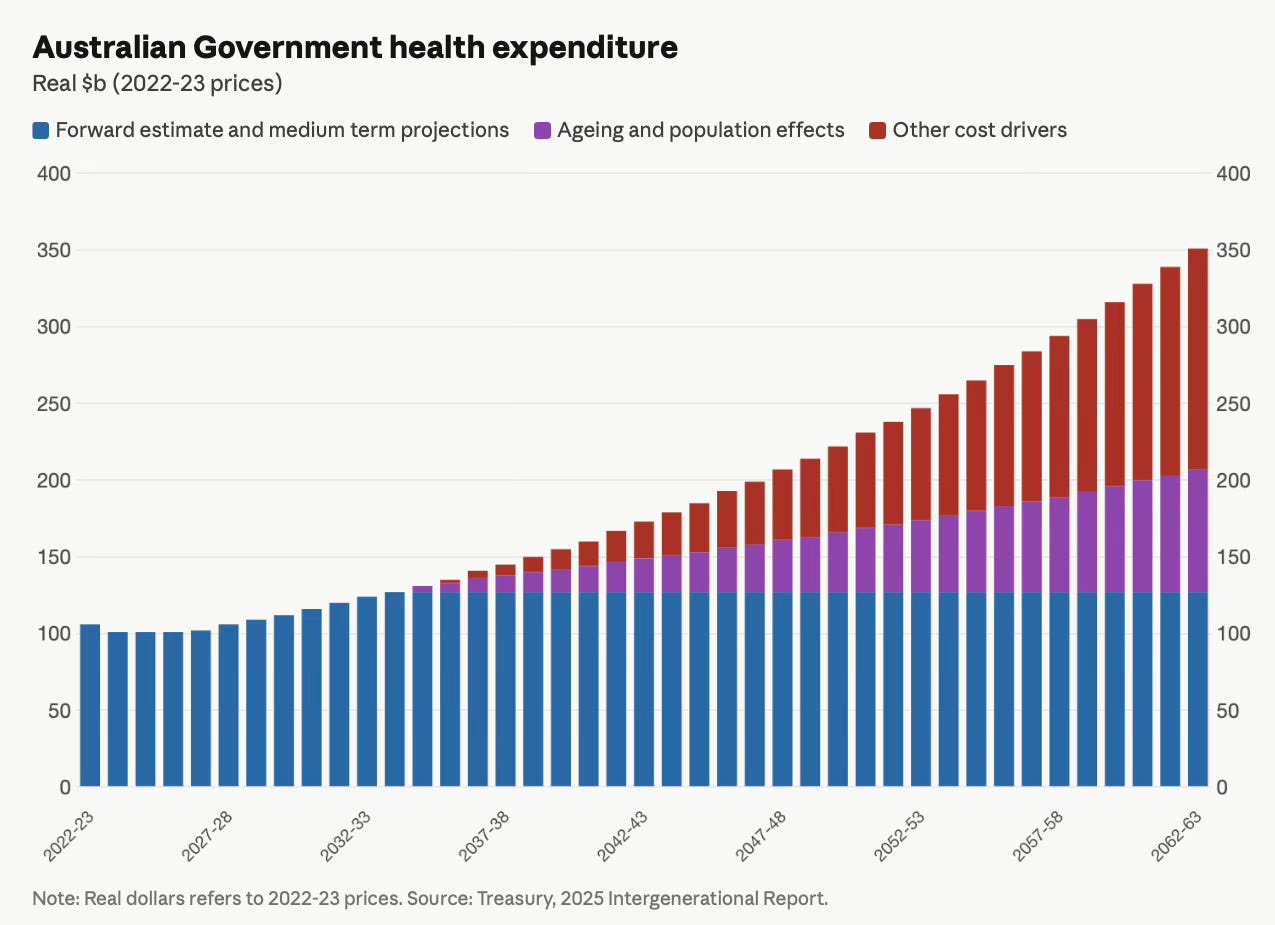
Source: Australian Government, Intergenerational Report 2023: Australia’s future to 2063
The rise of the ‘care economy’ is changing Australia
15. Most job growth is now in the non-market sector
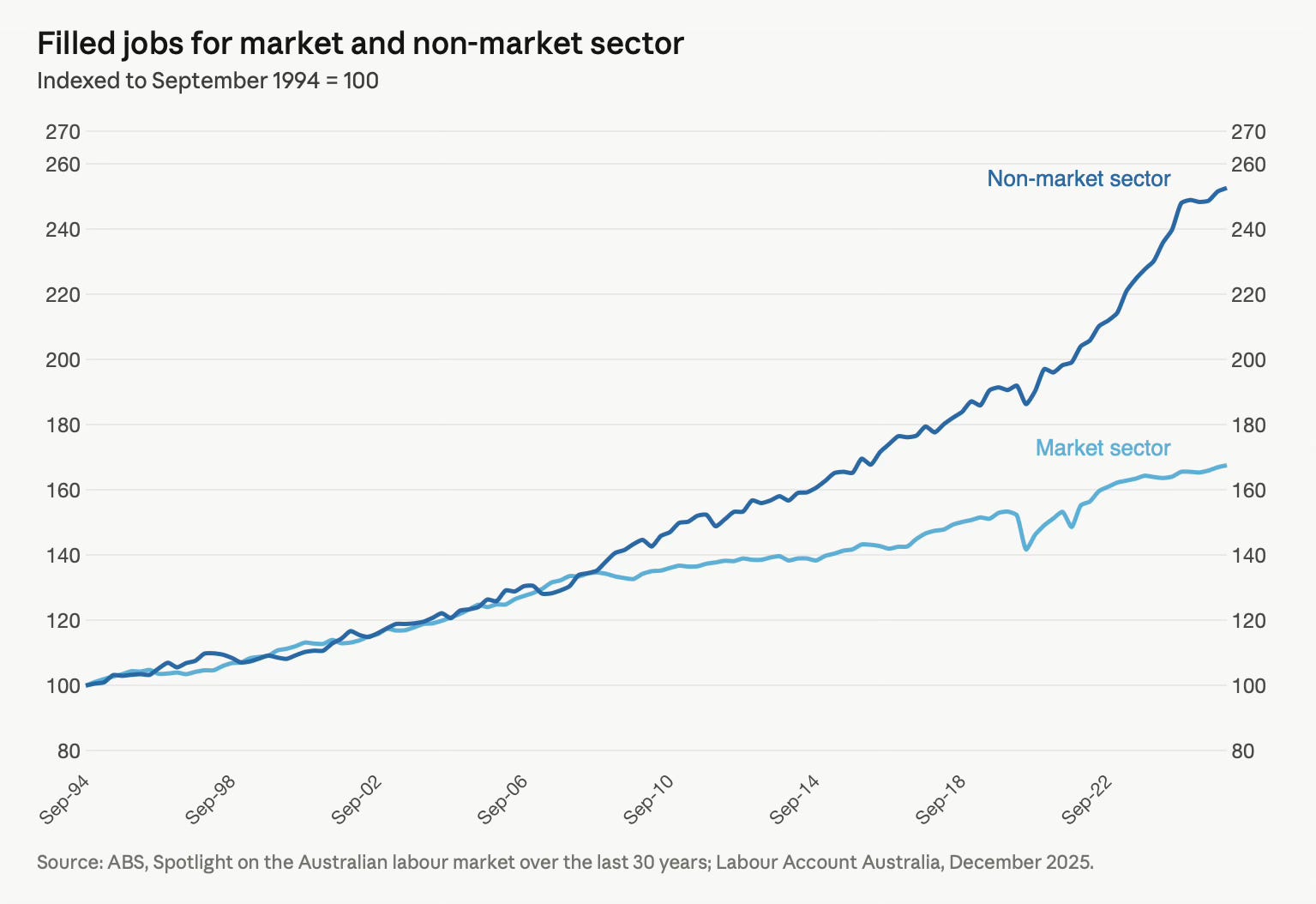
Source: Australian Bureau of Statistics, 2025-26 Medium-Term Budget Outlook: Beyond the Budget, September 2025
16. This isn’t unique to Australia, but it’s particularly acute here
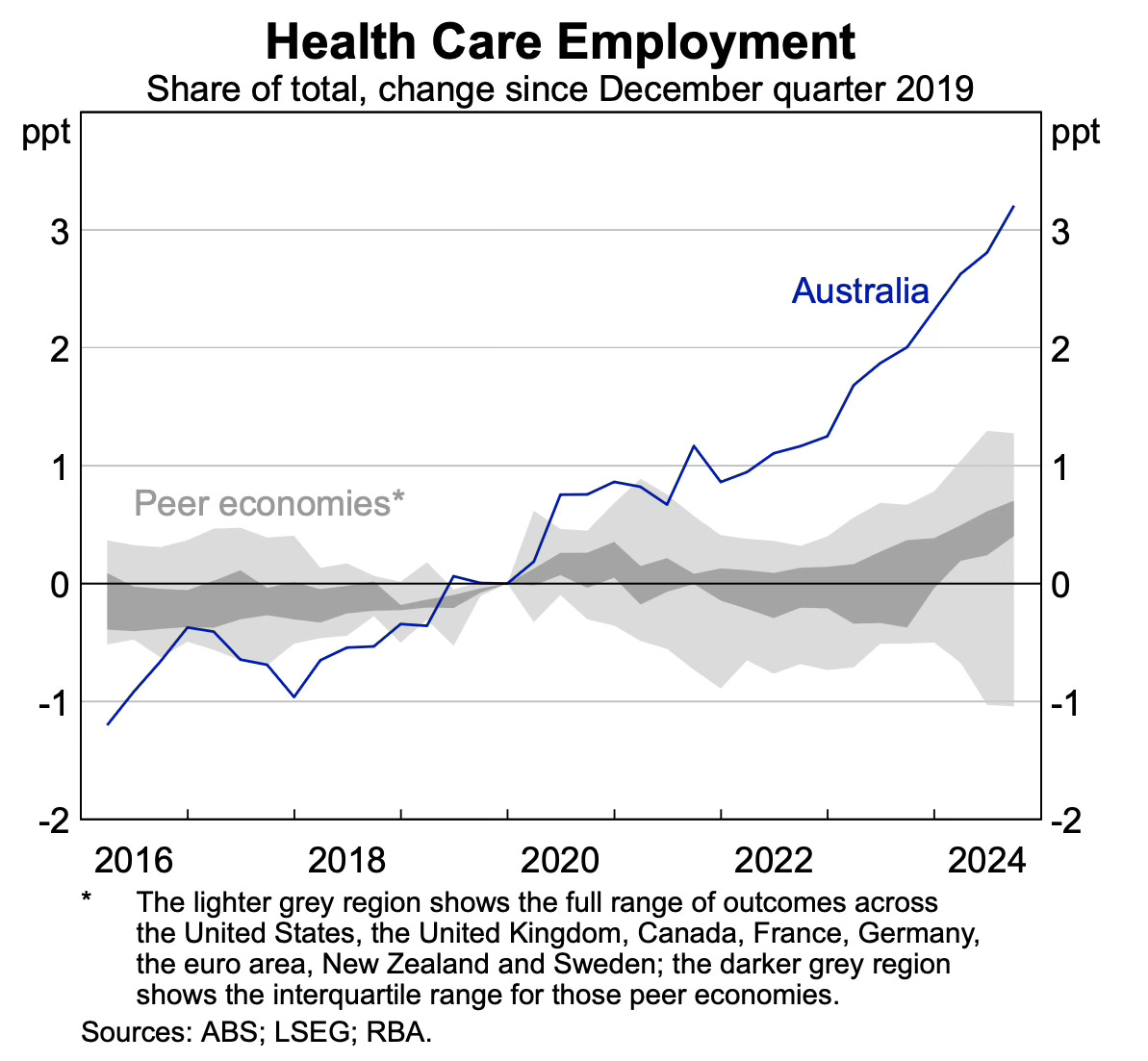
Source: RBA, Statement on Monetary Policy, February 2025, See Box C: Health Care Employment and its Impact on Broader Labour Market Conditions
17. And it partly explains why our productivity isn’t great
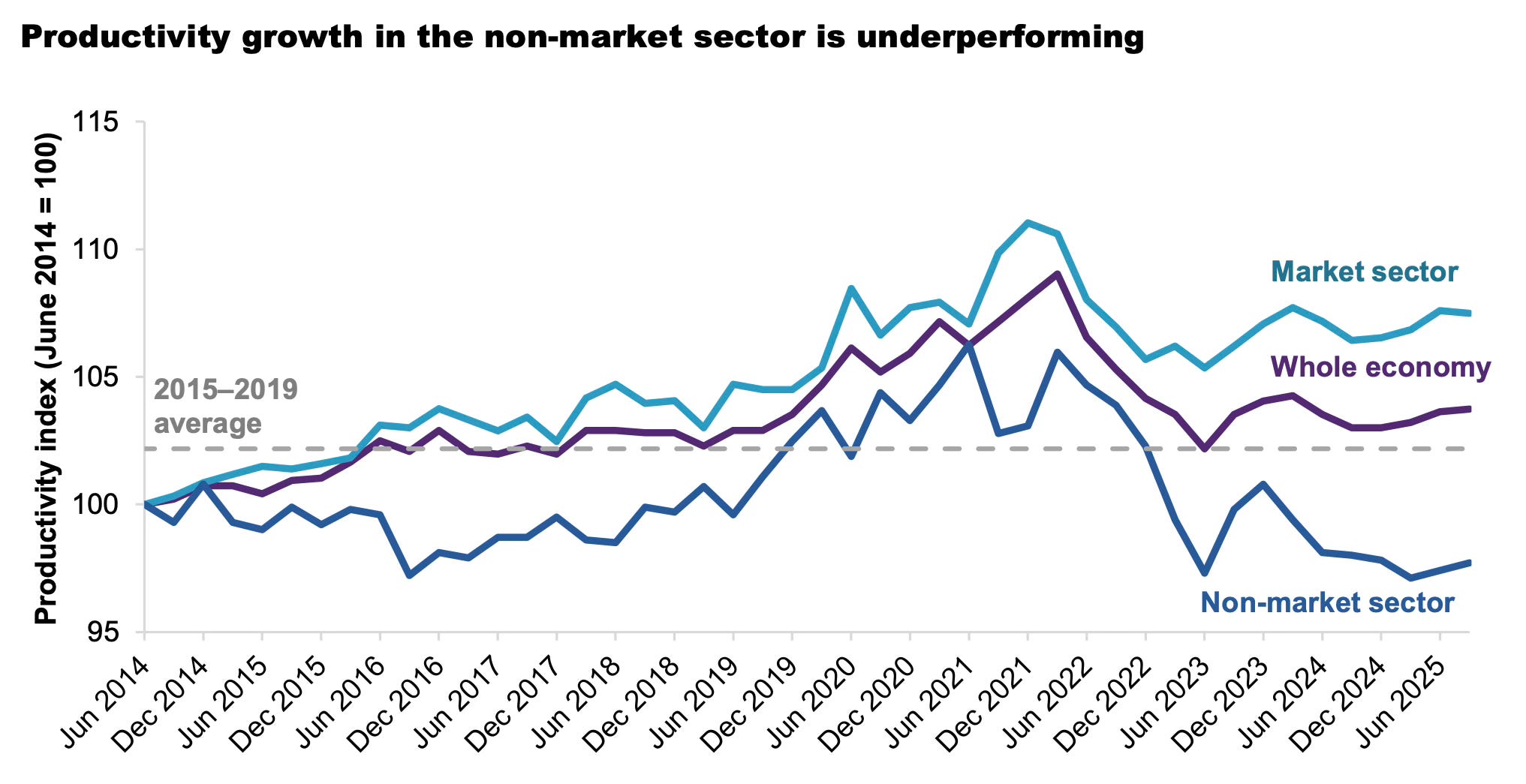
Source: Productivity Commission, Quarterly productivity bulletin, March 2026
18. Generous subsidies are accelerating this trend, and they aren’t always means tested. So Australia’s once highly-targeted welfare system is unwinding
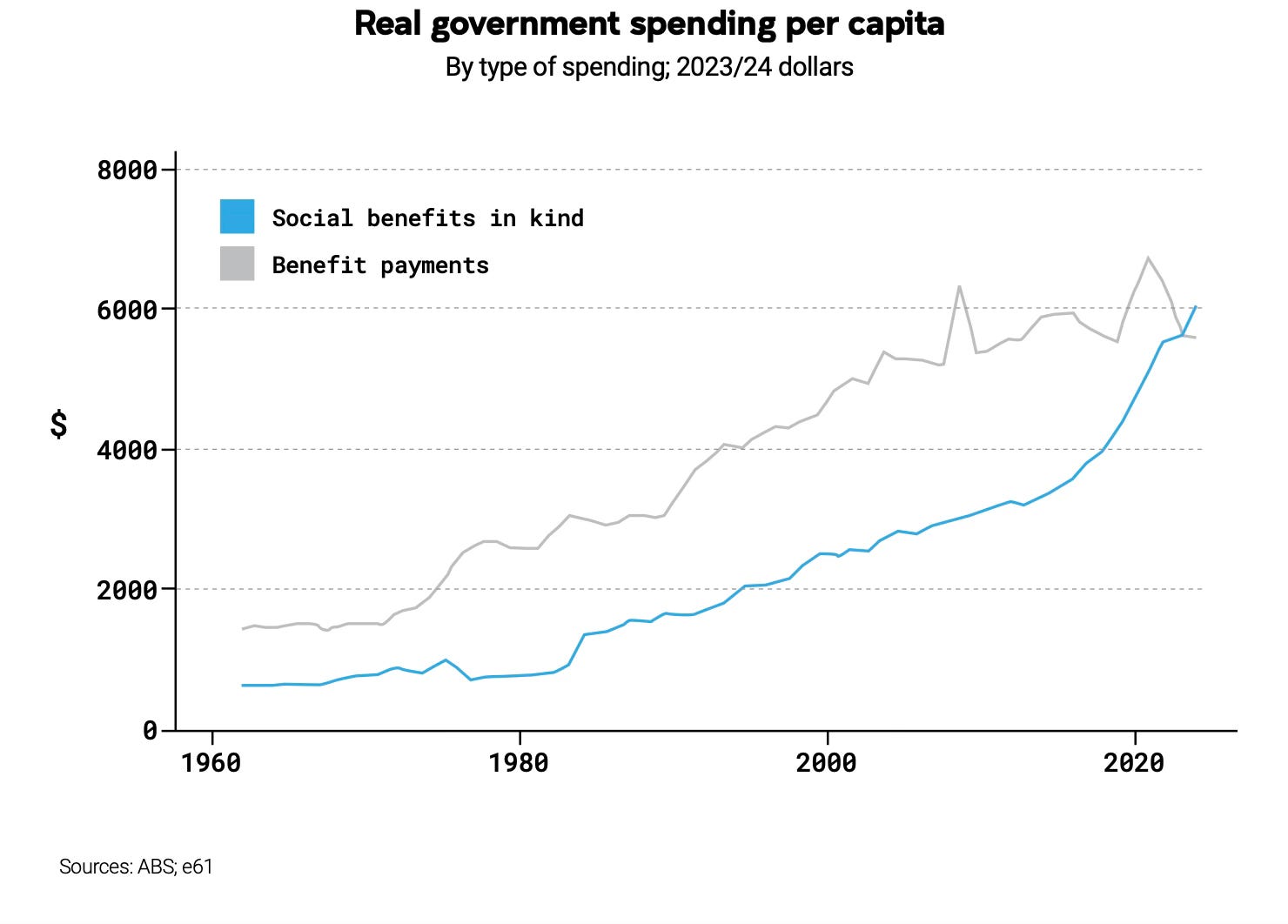
Source: e61 Institute, Five Economic Themes That Will Dominate the Next Parliament, 13 March 2025. ‘Social benefits in kind’ refer to subsidised services like the NDIS, aged care, & child care, which are typically less means-tested than ‘Benefit payments’, or cash transfers, to individuals/families.
Cost pressures on services are going up, but we’re not necessarily getting better outcomes
19. Hospitals are under strain
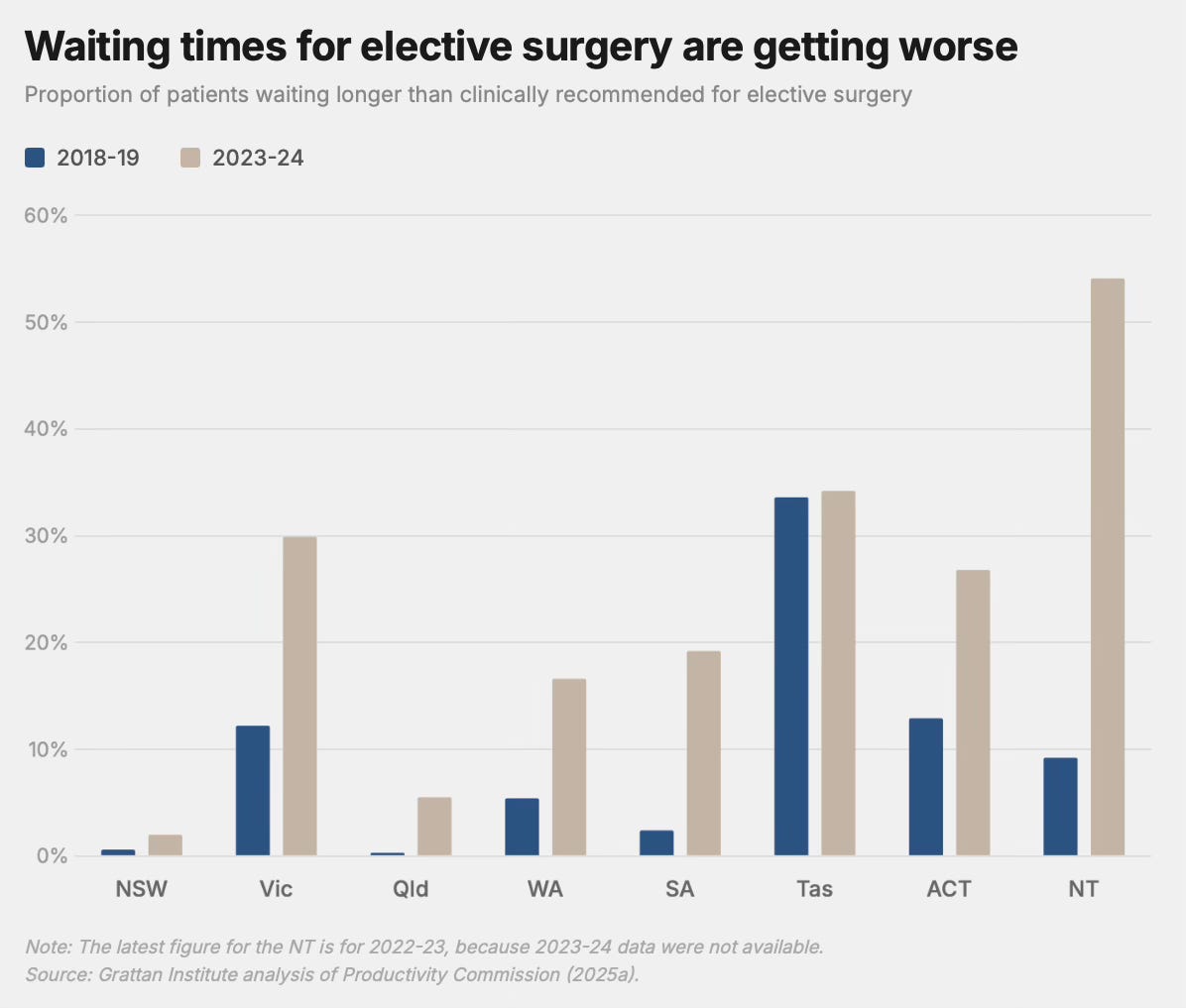
Source: Grattan Institute, Smarter spending: Getting better care for every hospital dollar, November 2025
20. School performance is either stagnating or getting worse
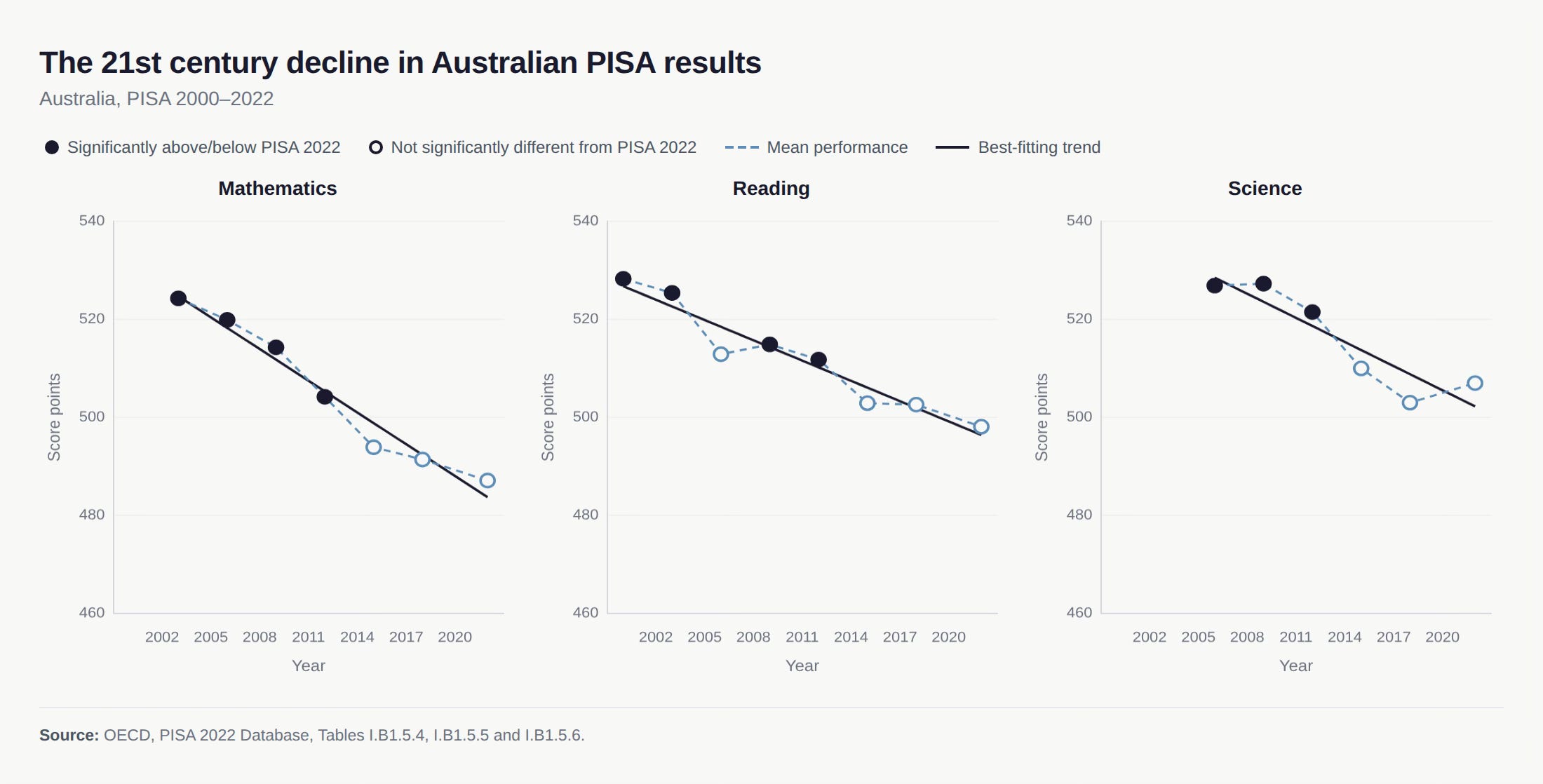
Source: PISA, 2022 PISA results, Factsheet, December 2024
21. School attendance hasn’t picked up since Covid
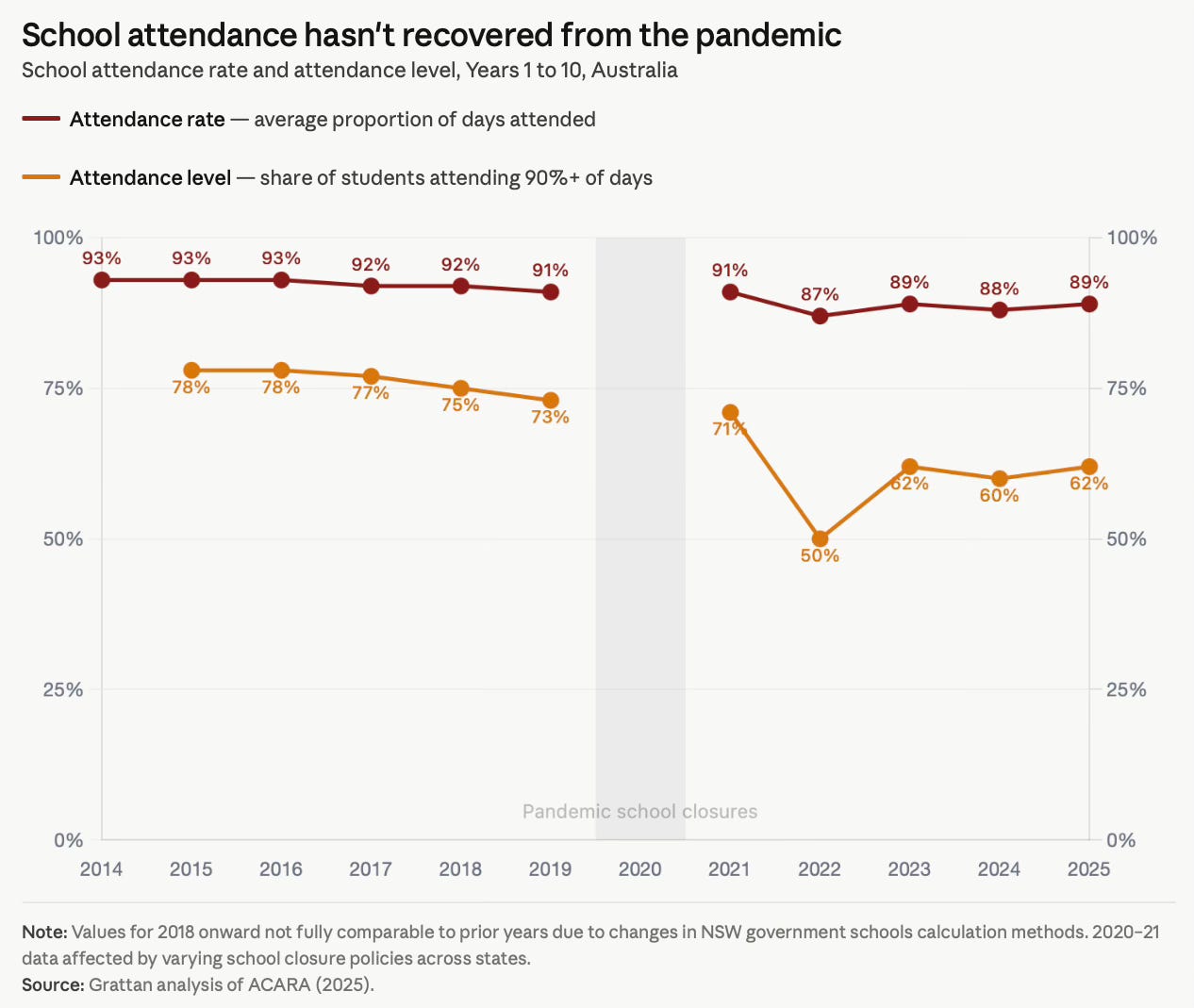
Source: Grattan Institute, ‘Every day matters: Improving school attendance in Australia’, Policy Brief, December 2025
22. Civics knowledge is plummeting
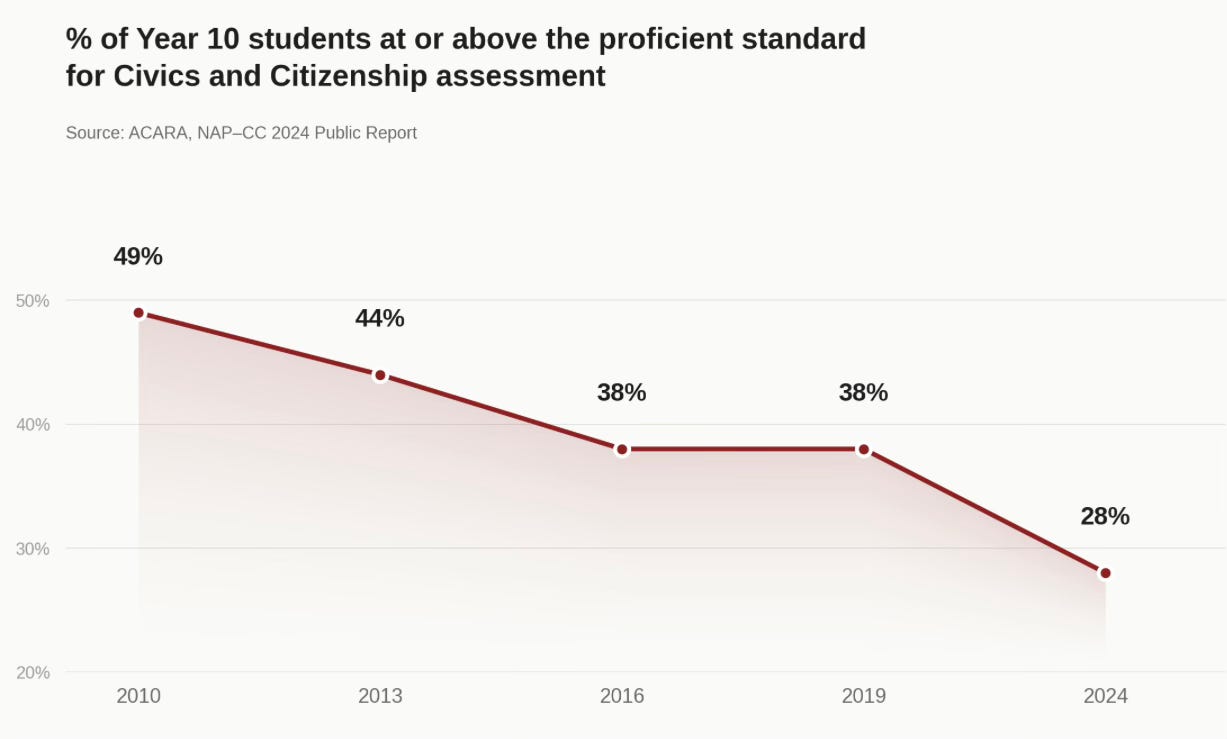
Source: National Assessment Program Civics and Citizenship 2024. Public Report, 2005
The social fabric is under strain
23. We have less of a sense of belonging in Australia
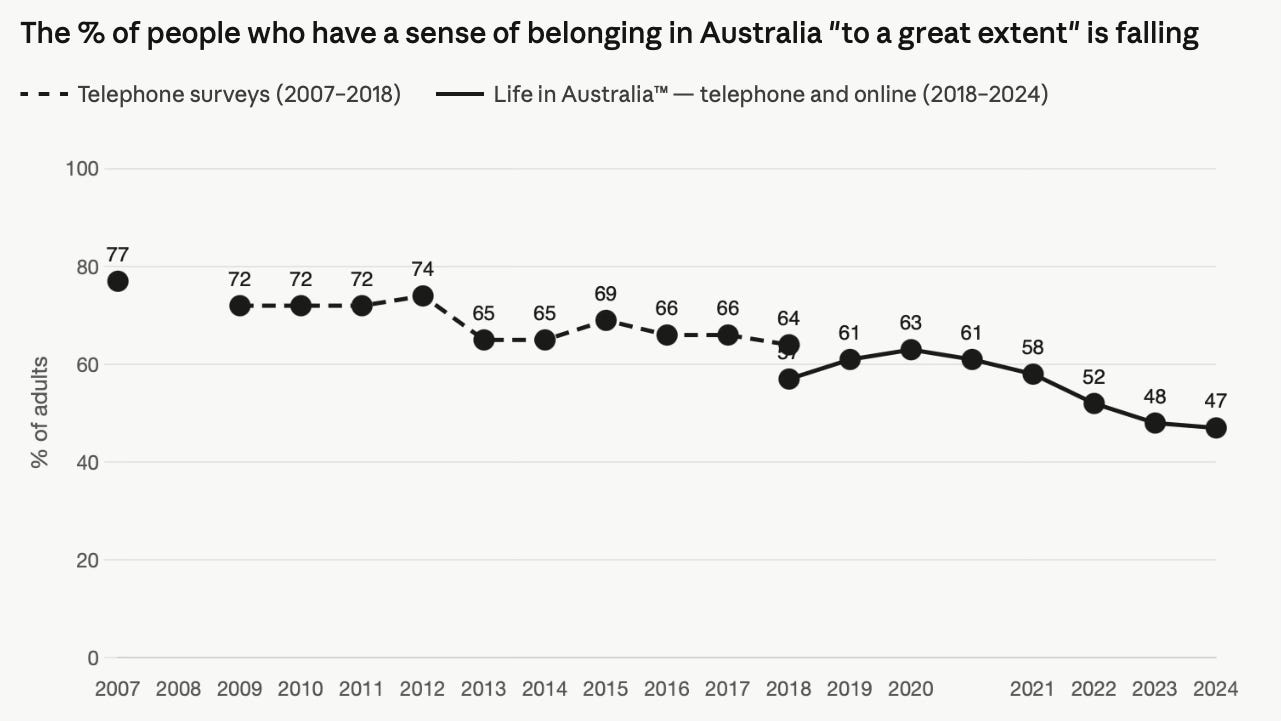
Source: Scanlon Foundation Research Institute, Mapping Social Cohesion 2024
24. People are volunteering less
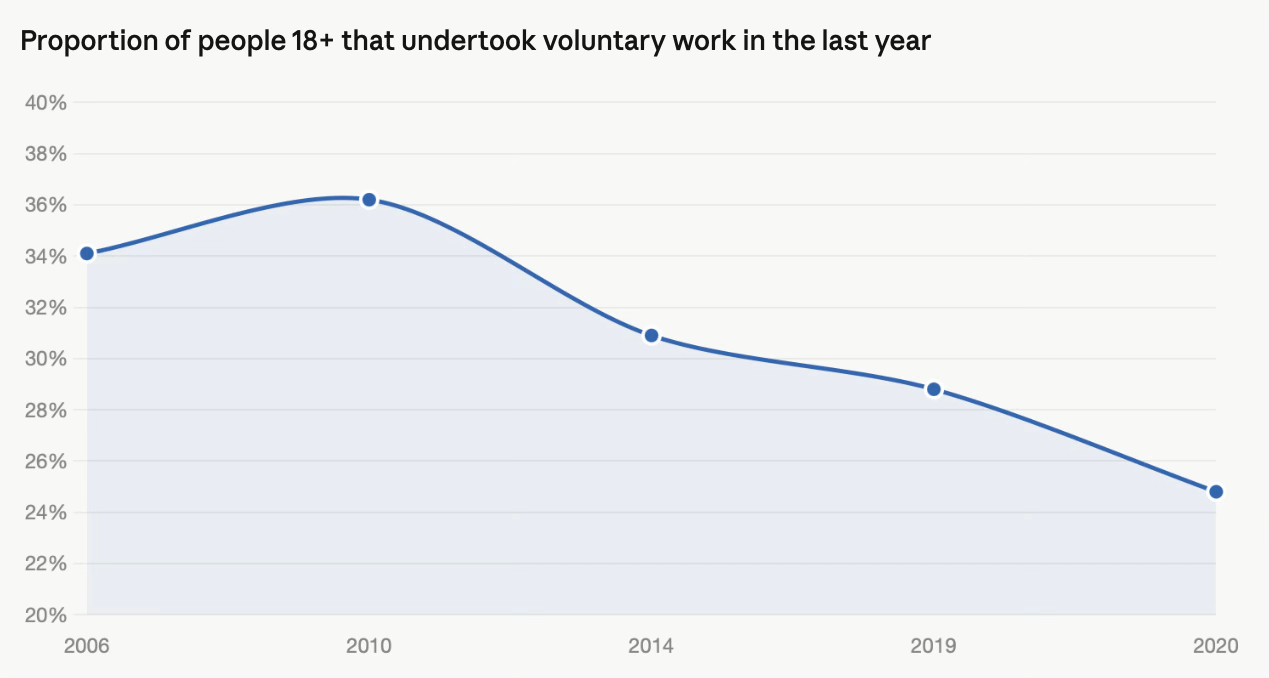
Source: Australian Bureau of Statistics (2021). More recent analysis by ANU suggests volunteering levels have not returned to pre-pandemic levels.
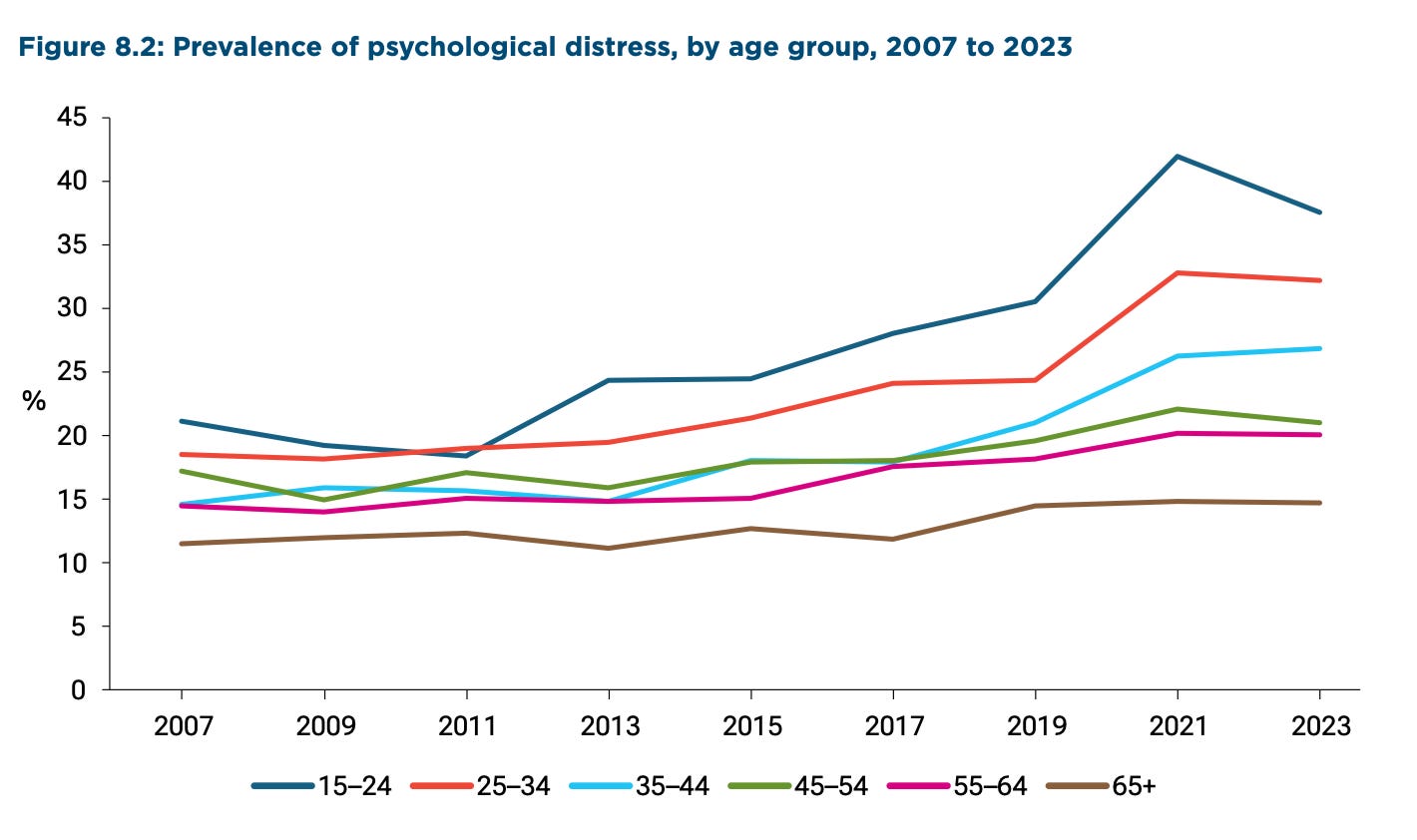
25. Psychological distress is on the rise, particularly for young Aussies
Source: HILDA Statistical Report (2025)
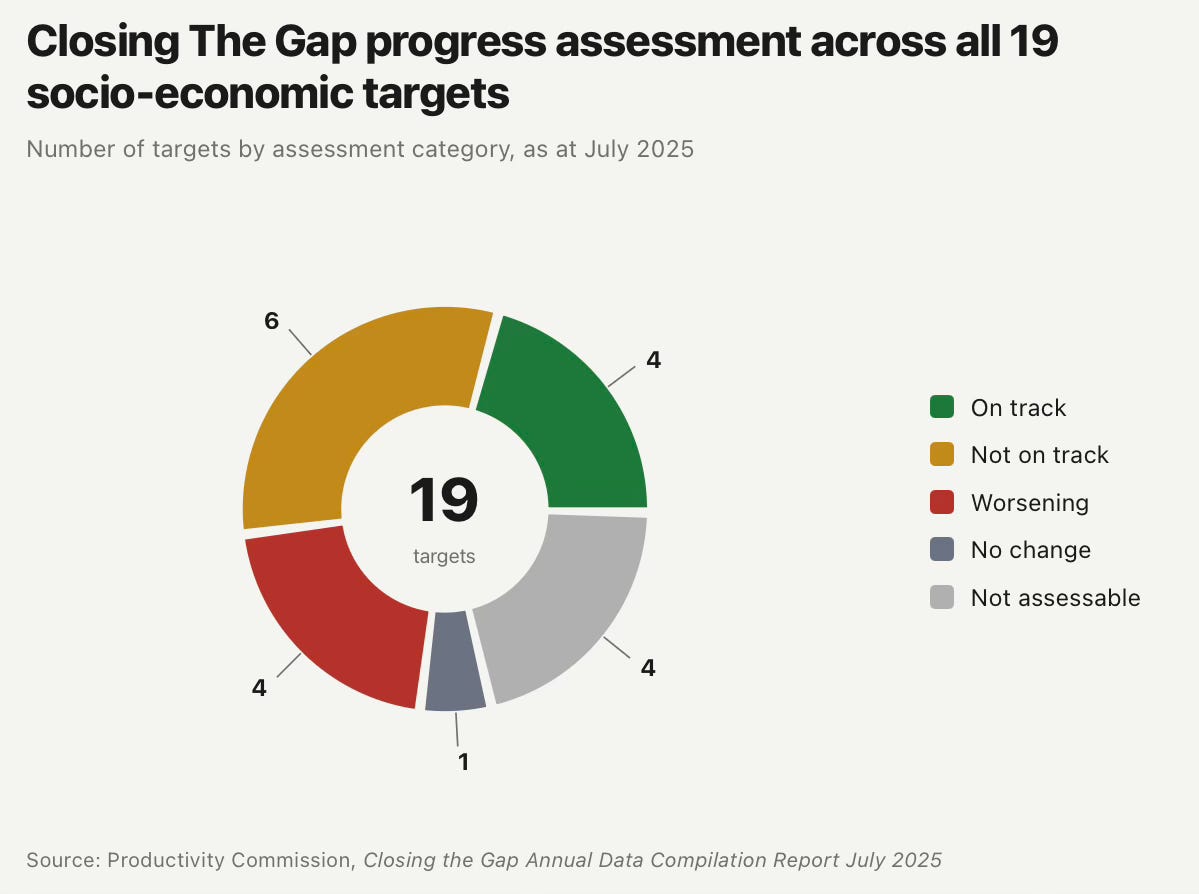
26. And we’re still not reducing the major inequalities between Aboriginal and Torres Strait Islander people, and non-Indigenous Australians
Source: Productivity Commission, Closing the Gap Annual Data Compilation Report, July 2025
Thanks for assembling these charts Andrew. My take on this is that for the last 25 years our political and intellectual class has been unable or unwilling to have honest conversations about the tradeoffs involved in pusuing various aims. Sure, we can give each first home buyer an eski full of gold, and this will flatten the equity curve a bit, but largely at the expense of the next most disadvantaged group who will now be priced out of the housing market by those with eskis. These type of schemes just move problems from one place to another. They do not solve any underlying issues or produce any tangible benefit to the populace as a whole.
But, in the spirit of tradeoffs, it would be great if you could delve into your treasure-trove of charts and looks for signs that things are improving. For example, dementia rates are falling off a cliff and unemployment is structurally lower. These things have real benefits to average people.
Your first few charts map a fall in satisfaction and expectation. How much of this has an economic and physical basis, and how much is driven by cultural and symbolic factors (per Carter's speech).
Andrew, thank you for pulling this together. You start from the useful truth that Australia is a great country by most measures, and that is exactly why the warning lights deserve attention.
For my work on Australian optimism, this is the right discipline: confidence without complacency. The data on living standards, productivity, private investment, school attendance, civics knowledge, belonging and young Australians’ psychological distress should not push us into despair. It should push us into reform.
A good country can tell the truth about strain and still believe it has the institutions, social trust and people to build better. The task is to turn anxiety into action, especially on productivity, housing, education, health, belonging and the fair go for the next generation. 🇦🇺