

The first full-length history of Australia written in English was published before the First Fleet landed at Sydney Cove in 1788. The History of New Holland, from its First Discovery in 1616, to the Present Time appeared in London in 1787, authored anonymously. It’s a compendium of information taken from the Dutch explorers of the 17th century, through to William Dampier and up to Cook’s voyage of 1770.
Several officers aboard the First Fleet even arranged book deals before their boats left Portsmouth. The founding of British Australia was a very
self-conscious enterprise, and the ‘story of Australia’ was being written as the ships sailed south across the North Atlantic Ocean to a land they knew nothing about.
All national histories inevitably ask the question “Who Are We?” But in Australian historiography it is asked more frequently and contested more often. In Inventing Australia, Richard White calls it ‘a national obsession’. That Australia ‘the nation’ was so closely tied to and conceived of as part of a grand imperial project inevitably set off the search for something tangibly and independently Australian.
The American identity rests unusually on political ideas; what is often described as ‘the American creed’. The Australian identity is more relational. The temptation is to judge ourselves against a foreign standard, or act according to one. That is partly a consequence of our imperial legacy. In 1950, A.A. Phillips called this a ‘disease of the Australian mind’ and gave it a term: cultural cringe. First it was the British standard. Then the American standard. Even talk of ‘pivoting to Asia’, though it carries the implicit aspiration of an ‘independent’ foreign policy, still situates Australia’s identity in relation to somewhere else.
A national identity is a hard thing to put a finger on. One of the casualties of this obsession is a skirting over Australia’s own political creeds - far less pronounced than in America, but they are there and important. Yet according to one well-regarded book, ‘Australia has no single, identifiable political tradition’. That is not true. Another feature is the practice of history writing itself, see-sawing between the construction and deconstruction of the latest ‘Australian story’ that holds sway.
This list goes back and forth between a good story and the deconstruction of stories. It also sticks pretty closely to my interests - political economy and institutions, particularly in the 19th century - so in that sense it is narrow and a little idiosyncratic - certainly not intended to be representative of anything except what I’ve found interesting, and what made me see Australia a little differently.
Book I give to someone who knows nothing about Australia
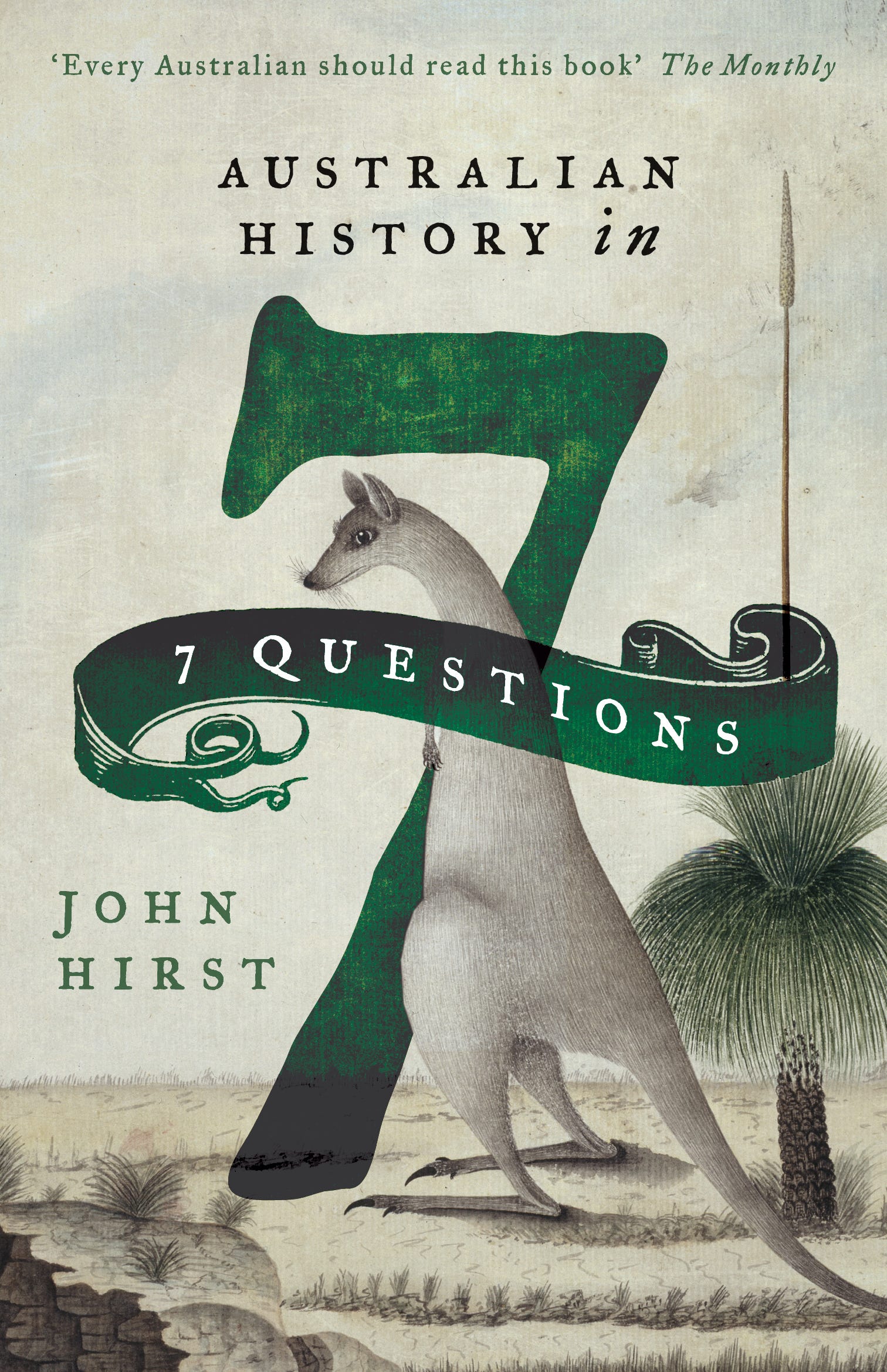
Australian History in 7 Questions by John Hirst (2014)
A good example of how asking the right questions is half the battle. This slim volume by the late historian John Hirst asks seven of them:
Why did Aboriginal people not become farmers?
How did a penal colony change peacefully to a democracy?
Why was Australia so prosperous so early?
Why did the Australian colonies federate?
What effect did convict origins have on national character?
Why was the postwar migration programme a success?
Why is Australia not a republic?
Hirst has a keen eye for how social relations mould political institutions. He was interested in the distinctiveness of Australia, and its from him that we get ‘Australians are suspicious of persons in authority, but towards impersonal authority they are very obedient.’ You don’t need to agree with all his conclusions to find this a useful launching pad into the big questions about Australia.
The most information-dense book

The Tyranny of Distance by Geoffrey Blainey (1966)
Although others had done so before, this was the first major work to question the ‘convict dumping ground’ rationale as the sole explanation for Australia’s founding. Blainey does it in his typical understated style by asking whether sending convicts to Australia was the most cost-effective solution to overcrowded prisons. He loves overturning old economic narratives, which this book does in almost every chapter.
The idea that Botany Bay could serve as a maritime base sets the theme of distance in this book. Where previous historians conceptualised early Australian history as the conquest of land, Blainey reverses the focus and writes about the conquest of sea. ‘The finding of a navigable stretch of water was often more important than the finding of an immense area of cultivatable land’ he wrote of the early years. For a time the Australian continent was judged primarily by its usefulness within a rapidly growing maritime trading system, where ships could stop along the way to the East Indies.
The opportunities of Australia, and the extravagant cost of getting there, forced people to do some remarkable things to bring the two into some kind of workable equilibrium. Blainey’s chapters on exploiting the Roaring Forties, whaling, the rise of the American clipper, the advent of coal, are all gripping economic history. Don Watson said of it that there’s a revelation on every page, and he’s not wrong. I learned that Tasmania didn’t have an interstate telephone link until 1936, and even by 1961-62, there were, on average, only about 16 international telephone calls per hour made in Australia.
The best literary non-fiction
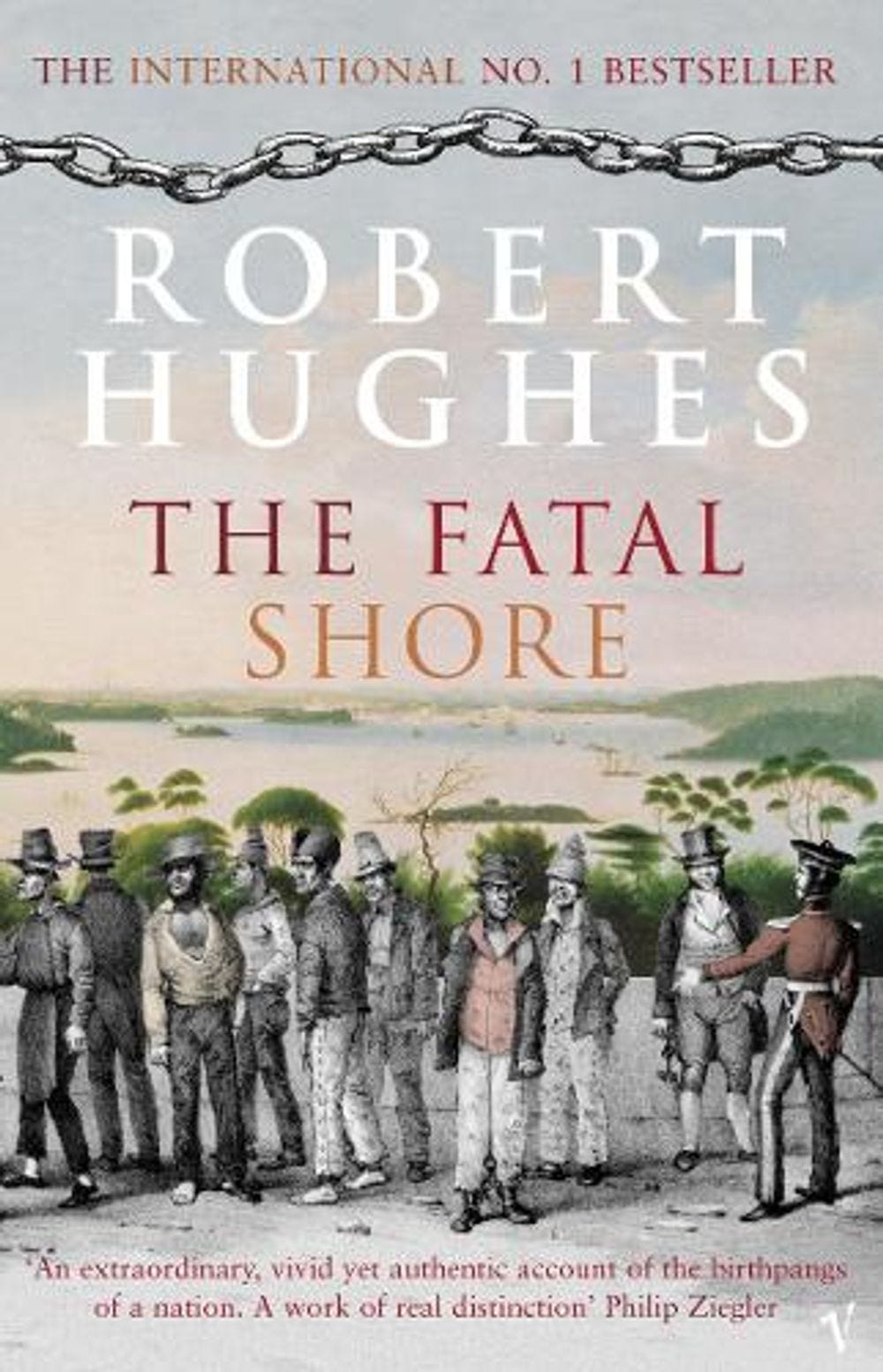
The Fatal Shore by Robert Hughes (1986)
There is a style of history writing that Britain and America do very well, and I wish Australia did more of. It reads like a well-crafted novel while retaining (mostly) scholarly integrity. I’m thinking about the great Barbara Tuchman, Bruce Catton, David McCullough, Walter Lord, Margaret Leech.
The authors are not typically academics - although they can be. They’re journalists, good with a pen and not afraid of an archive or two. In this category, The Fatal Shore stands out amongst its Australian counterparts.
Robert Hughes was the longstanding art critic for Time magazine. A self-described ‘unrepentant elitist’, he wanted to explode certain national myths in this book. He hated the caricature of the innocent convict, unfairly punished, fiercely independent and egalitarian - the prototype of the modern Australian man.
Hughes brings the darkness back to convict times. He focuses on the so-called places of ‘secondary punishment’, where convicts who committed further offences were sent. These were brutal settlements, and Hughes gives us every bloody detail. Here is a passage on the treatment of mutineers at Norfolk Island in 1834:
In a prolonged sadistic fury, Fyans and the soldiers of the 4th set out to make the mutineers wish they had never been born. It took the blacksmiths nine days to make new irons for the prisoners: they were double or triple weight, with the inside of the basils jagged to lacerate the flesh. Rebels locked in the jail awaiting trial were kept naked in a yard so crowded that not a third of them could sit at a time. For the next five months … the rebels were kept locked to a chain cable and ‘disciplined in a state of nudity for four hours each day, with their arms up and fingers extended, and such of them as betrayed the slightest emotion of pain, were either stabbed by the Military or flogged on the spot.’ One of the soldiers’ amusements, encouraged by Fyans, was to choose a prisoner at random and get one of the floggers, for a plug of tobacco, to thrust a stick into the cord that bound his arms, twisting it round and round until blood burst from his fingertips.
Australian history written as nineteenth century epic
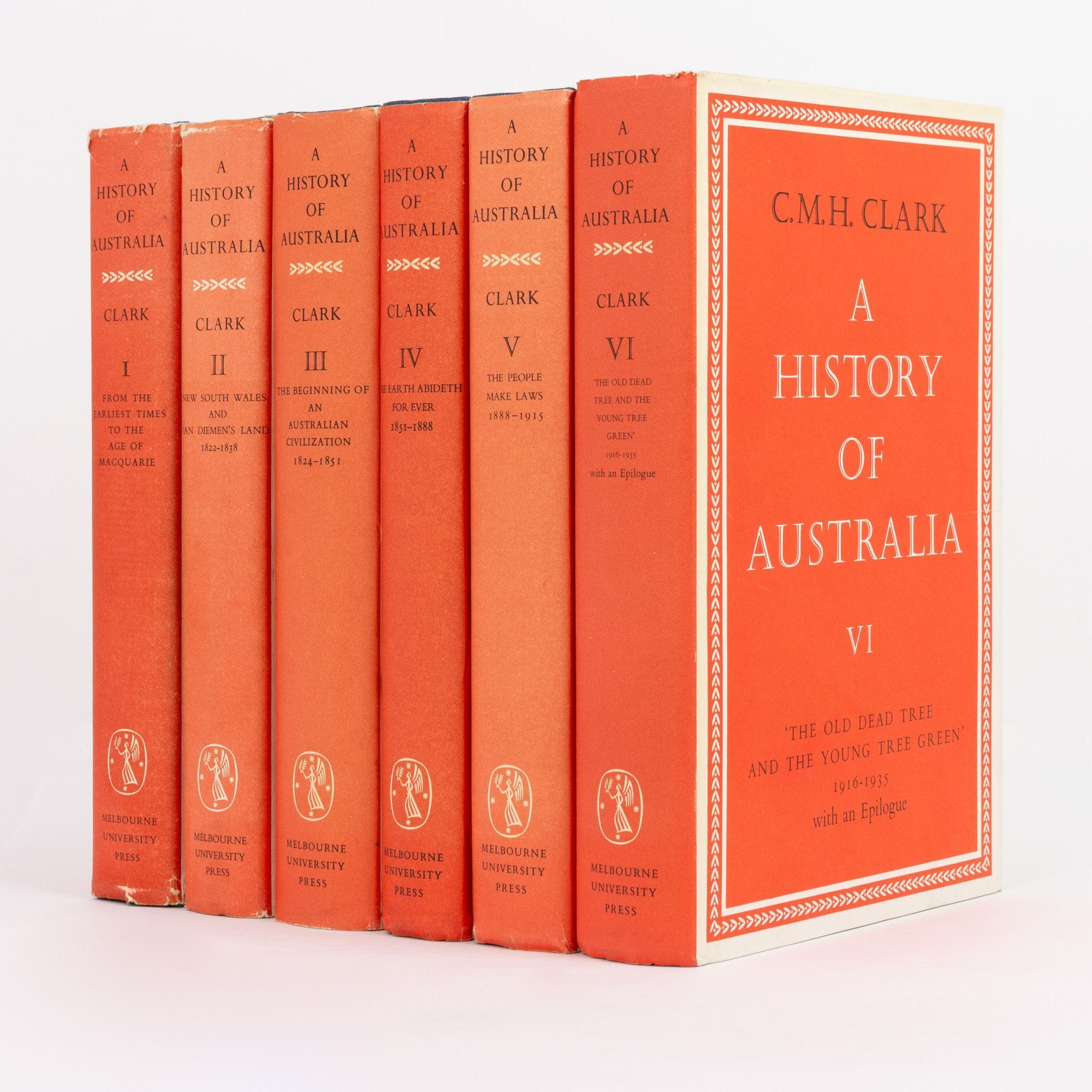
A History of Australia (6 volumes), by Manning Clark
In Mark McKenna’s very good biography of Manning Clark, he quotes the historian in a 1938 letter to his wife:
I feel certain that I can write something one day on Australian history … I believe quite passionately that Australia is a ‘weird’ country and that its weirdness has never been portrayed except in landscape painting. Australia is virgin soil in this respect & I feel something can be done about it. My whole being is rooted in Australia, and I don’t feel the temptation to betray her, to leave her. The other night, I was invited to dinner … and held forth quite passionately on the ‘weirdness’ of Australia to an interested audience. I felt quite exhilarated afterwards.
With the benefit of hindsight, it seems quaint that Manning Clark’s six volume history of Australia, published between 1962 and 1987, became a lightning rod for the so-called History Wars. There’s more D.H. Lawrence than Karl Marx in these books; certainly more Carlyle, whose clash of abstractions in the The French Revolution: A History - ‘Royalism’ and ‘Sanscullottism’ - are transposed onto Clark’s Australia as the clash of Catholicism, Protestantism, and the Enlightenment.
Yes, it is polemical; yes, it is not always (or even mostly?) reliable. But I return to what another Australian historian, Geoffrey Bolton, said of it: “one of the major works of history undertaken anywhere in the English-speaking world during the second half of the 20th century”. And it was about Australia.
General histories of Australia

The Story of Australia’s People, Volume 1 by Geoffrey Blainey (2015)
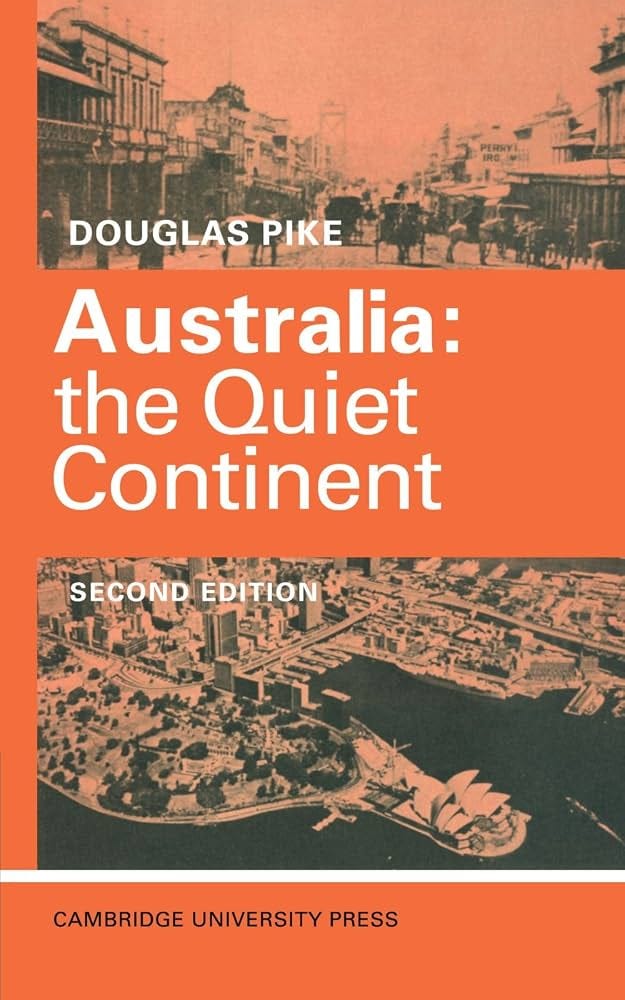
Australia: the Quiet Continent by Douglas Pike (1970)
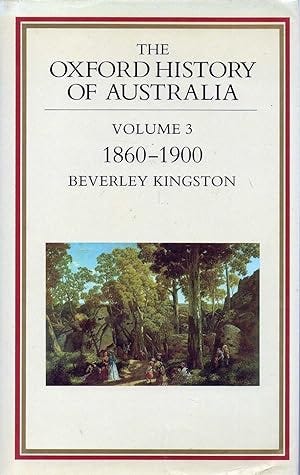
The Oxford History of Australia, Volume 3, 1860-1900 by Beverley Kingston (1988)
I’ve picked three that offer something a little different. Geoffrey Blainey’s two-volume The Story of Australia’s People - which is partly a rework of two previous books - has one big innovation: expanding the pre-1788 history so that it covers almost two-thirds of the first volume. This period, he notes, ‘is now the most innovative, exciting and controversial section of Australian history’. Together with his literary prose it makes for a great introduction. It also offers, for popular history, a path forward in writing about pre-European Australia that is exciting, and which situates it in a grander narrative of humanity reckoning with the great southern continent.
Between 1945 and 1970 there was a surge in national history writing, many of it excellent. The common thread running through each of them was the search for an independent Australian identity. Douglas Pike’s The Quiet Continent, published in 1970, is a little more idiosyncratic and existential (“The Australian story is something like a fun-fair. The same things happen again and again”). Where most mid-century histories celebrate Australia’s independent democratic egalitarianism, often closely associated with the labour movement and radical politics, Pike interprets it more cautiously. His Australians are more conservative, more concerned with financial security and security against outsiders. They prize stability. Given where national politics is today, maybe Pike was onto something.
A third pick. From the mid 1980s to mid 1990s, five volumes were published that formed part of the Oxford History of Australia. Beverley Kingston’s volume covering 1860 to 1900 is the standout. These are the most important 40 years as far as Australia’s modern political development is concerned, and Kingston narrates this period thematically (‘Materialism’, ‘Belief’, ‘Society’, ‘Culture’, ‘Power’). This is another information dense book. I learned, for instance, that South Australia had the lowest insanity rate of any of the colonies. Kingston is also very perceptive. Here is one paragraph on how the scarcity of women in colonial Australia affected gender relations in the country:
Women expected to marry. Men feared they might not. Women could afford to play the field, and evidently did, more or less from the time they left school. Men were frequently forced to lower their expectations. Young women were in a relatively powerful position because of their scarcity value. But once a woman married she lost that power and significance. It is not difficult to detect in the columns and cartoons of the illustrated newspapers and magazines a deep feeling of resentment against women, the power they could wield as mere girls, the constant threat of emotional blackmail as wives.
Game-changing book about Australia
Convict Workers: Reinterpreting Australia’s past, Stephen Nicholas (editor), (1988)
One of the criticisms of Hughes’ Fatal Shore was that it gave a misleading view of how the convict system actually worked. By focusing too much on the places of secondary punishment, where the most brutal treatment occurred, Hughes was said to have missed the broader success of the system as a whole. You could read the Fatal Shore and not understand how Australia morphed into a relatively prosperous democracy.
Coincidentally, Stephen Nicholas’s edited book Convict Workers came out two years later, and painted a very different picture. The intellectual context for Convict Workers was the revolution in economic history research, drawing on economic theory and quantitative analysis to get a deeper insight into economic and social phenomena.
At the centre of this book is data on 19,711 convicts transported to NSW between 1817 and 1840, or about one-third of the post-1817 convict inflow into NSW. From this sample the author’s are able to draw some surprising conclusions about convicts and convict life:
Convicts were relatively well fed. Compared to other systems of forced labour, convict rations were relatively substantial.
The average work week for convicts was shorter than many British free labourers were used to.
Flogging wasn’t nearly as prevalent as popular history made it out to be (about two-thirds were never flogged).
The occupational structure of convicts broadly resembled the British and Irish working classes - so this was not a criminal underclass as the negative stereotypes suggested.
Rewards mattered as much as punishment in the convict system, and in fact were more important.
As critics of Convict Workers pointed out, statistical averages hide a lot of variation in what was a complex and changing system. Nonetheless, no discussion on Convict Australia is complete without some reference to the analysis undertaken by Nicholas and his team.
Most interesting account of Australia by a foreign visitor

The Webbs’ Australian Diary 1898, A.C. Austin (editor), (1963)
The leading Fabian Socialists of their day, Sidney and Beatrice Webb co-founded the London School of Economics in 1895, and occupied the interesting position of being political outsiders, but very much professional insiders. Their visit to the United States, Australia, and New Zealand in 1898 occurred at a moment when the New World offered, perhaps, new lessons on what full blown democracy might look like. The Webbs were a preview of the new 20th century administrative elite: professional, meritocratic, with enormous faith in technical and theoretical knowledge to solve all human problems, coupled with the faith that government had to be big enough and strong enough to let experts have their way. Most of what they wrote has held up very badly, but their published Australian diary is insightful, funny, and even worth reading for the bad judgements. Here is one paragraph:
Australia is utterly and completely unlike America in every respect. From top to bottom there is absolutely no likeness or analogy. So whatever discouragement you derived from America - in the quite unfounded belief that the U.S. is a Democratic country - this place would restore your spirits and persuade you that what is wrong in the U.S. is the peculiar copy of 18th century Toryism that Hamilton fastened on America 120 years ago. Not that this place is “advanced” - it is very much what England was in 1870. But owing to their having copied the real English constitution of 1850-60, instead of the nominal English constitution of 1789, you have here a genuine Democracy, the people really getting what it wishes to get. The politicians and the newspapers are in fact, the best product of Australia; and they are very good indeed. The trouble is that the people are an exceptionally Individualist graft from our Individualist epoch (1840-1870); and they are all of them gambling profit-makers, keen on realising the Individualist ideals of the lower Middle Class of 1840-70 … I don’t find that the Australian Democracy was or is based on any abstract ideas or arbitrary psychology. We are interested to find it really an admirable success in all its essentials - purity, public spirit and results. What it lacks is intellectual leadership, but this is lacking in the colony as a whole. What there is goes into politics, and certainly no conceivable other system of government would have produced anything like such good results.
Best economic history of Australia

Why Australia Prospered: The Shifting Sources of Economic Growth by Ian W. McLean (2012)
This seems to be the standard text for Australian economic history, and for good reason. McLean’s book is the product of many decades of teaching and research. It is in some sense the summation of a life’s work.
On one level, Why Australia Prospered is a classic long-run, comparative, macroeconomic history. But McLean is very adept an incorporating the institutional story too. Take his account of land policy in the early-mid 19th century. Rather than grant freehold to the small number of pastoralists who occupied (and killed for) tens of thousands of square miles of property, the colonial government kept it leasehold for as long as possible, until the colony became self-governing and democratised. McLean speculates, quite compellingly, that this helped Australia avoid a much more powerful landed oligarchy, dodging the Argentinian road to institutional decay.
There is a touch of economic determinism in the book. McLean is less interested in specific economic policy decisions than the structural story. Most policy he treats as a rational, if contestable, response to prevailing conditions. There is another history to be written that sharpens the focus on these decisions. There’s certainly a lot more to be written about Australia’s inward turn in the late 19th/early 20th century and its economic and political consequences. You can get a sense of these problems in this interesting Productivity Commission paper on Australia’s long run productivity experience. Regardless, more historians should be taking up Australian economic history.
Most eye-opening book
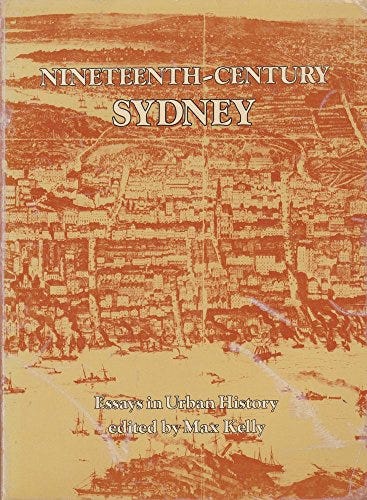
Nineteenth Century Sydney: Essays in Urban History, Max Kelly (editor), (1978)
Before he became one of the founders of the marginal revolution in economics, William Stanley Jevons lived in Sydney for about five years in the 1850s, working as an assayer at the Mint. During that time, he walked all over the city, Chris Arnade style, and wrote about what he saw.
He believed the poverty he witnessed in Sydney was worse than in London. He walked through hidden lanes and backstreets, where the worst slums were out of view to most city residents. Whether that comparison was fair is hard to say, but Max Kelly’s edited collection of urban essays on Sydney gives us a glimpse of this world. Kelly’s own chapter ‘Picturesque and Pestilential: The Sydney Slum Observed 1860–1900’ will give you a side of Sydney that is largely left out of most general histories.
In 1875 - when Australia’s per capita GDP was the highest in the world - a confluence of epidemics swept upon Sydney and pushed the city’s death rate to about 32 people in every thousand, higher than in comparable western cities. About 47 per cent of all city deaths that year were children under five.
What becomes obvious from Kelly’s book is that local government in New South Wales was astonishingly bad. From the beginning, Sydney was governed centrally, first by the Governor and later by the NSW colonial government. Much of the land in Sydney was owned by the government and therefore not subject to council rates. Local government revenue raising capacity was always hamstrung. And the Australian preference for independent authorities to administer policy often led to highly fragmented local government systems with little accountability.
Hottest Take about Australia
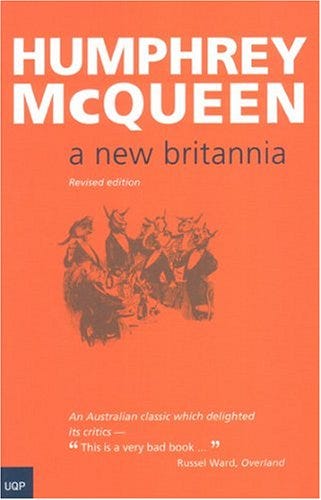
A New Britannia: An argument concerning the social origins of Australian radicalism and nationalism by Humphrey McQueen (1970)
My favourite chapter this book is Chapter 9: Pianists. McQueen suggests some 700,000 pianos were brought into Australia in the nineteenth century. Not just the preserve of the middle/upper classes, ‘it was also the pinnacle of working class aspirations’. Pianos were lugged inland along dirt tracks, where they might form part of a wall in a wooden hut.
‘A working class that could afford such luxuries wanted nothing to do with revolution’ writes McQueen, who saw in the convicts, in the diggers, labourers and small-bit farmers not a class-conscious proletariat but a conservative and aspirational petit-bourgeoisie. In McQueen’s own Marxist worldview, this was all rather pathetic, but there is of course a liberal reading of New Britannia that offers a more benign view of aspiration. That is not McQueen’s reading of course, which is cynical and acerbic, implicitly praying for a revolution that has no chance of eventuating.
Frontier conflict books about Australia

Nicholas Clements, The Black War - Fear, Sex and Resistance in Tasmania, (2014)

Jonathan Richards, The Secret War - A New History of Queensland’s Native Police, (2008)
Beyond the so-called ‘History Wars’ that pits ‘Australia Good’ against ‘Australia Bad’, there is a more subtle debate taking place between old-fashioned empirical history versus a kind of moral or ethical history. This is not a strictly left vs right issue, but a debate about historical method and the extent to which we can understand the past through the traditional tools of evidence. Jonathan Richards and Mark Finance’s 2024 article Speculating about genocide: The Queensland frontier 1859–1897, is a cry for empirical rigour in a field that must also accommodate very sensitive political and moral claims. They are critiquing, I think, the tendency to allow moral conclusions to determine in advance what the evidence must show.
Nicholas Clements The Black War doesn’t make this mistake. His book is about the Aboriginal and settler conflict in Tasmania in the early nineteenth century. H.G. Wells’s The War of the Worlds is said to have been inspired by this episode. The Black War’s best feature is its very extensive archival research to reconstruct the conflict as it was experienced by the Aboriginal people and colonists who fought it. He writes:
The near extermination of the Tasmanians cannot help but evoke emotions such as guilt, sadness and contempt in any feeling person. Yet it is misleading to think of the Black War as a battle between good and evil. The traditional dichotomies of strong and weak, cowardly and courageous, victim and victimiser simply do not stand up to scrutiny. Practically everyone saw themselves as the victims. White and black alike, most were just trying to survive the nightmare in which they found themselves.
Jonathan Richards’ The Secret War is about the worst chapter in Australian history: the Queensland Native Police. This was, in essence, a paramilitary force - peaking at about 250 in the 1860s - divided into units, each unit typically comprising a European lead and a few Indigenous mounted troops enlisted from far distant country. Their job was to ‘protect’ the expanding pastoralist class by ‘dispersing’, meaning shooting at, the local groups. The impact of the Native Police and the scale of their killings were a bit of a black box to Australian historians until recently. The individual stories are aplenty - pick up any memoir by a colonial Queenslander of the mid-late 19th century - but details of their actions are scattered across archives, leading to the now-dispelled myth that there was some kind of state cover up of genocide, with records deliberately destroyed. Richards shows this was not the case.
The question of genocide looms over this subject matter. Both Richards and Clements treat this claim seriously and empirically. Neither are comfortable using that term. Richards writes that “evidence cannot be found to conclusively prove that the Queensland government was directing or even condoning the killings performed by the Native Police.” That conclusion is a function of the definition of genocide, which requires intent. Of course, one can be complicit without genocidal intent. But the more important lesson, I think, is that we can get caught up in trying to fit the past into modern categories if those categories carry important legal or political currency. But it may not help us understand the past on its own terms. “What this really means is that we need some other terminology to express dramatically and honestly what some agents of colonisation and their hirelings did to Aboriginal people”, Richards concludes.
Books about Australia that are not specifically about Australia
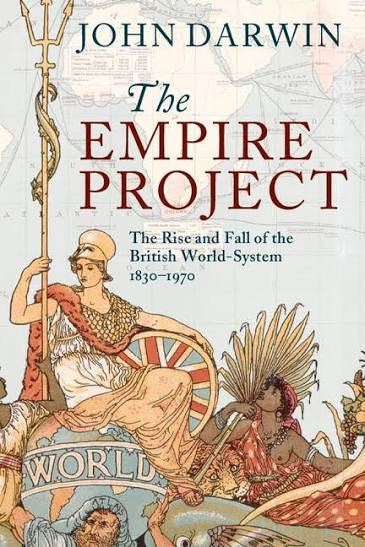
John Darwin, The Empire Project - The Rise and Fall of the British World System 1830 - 1970, (2009)
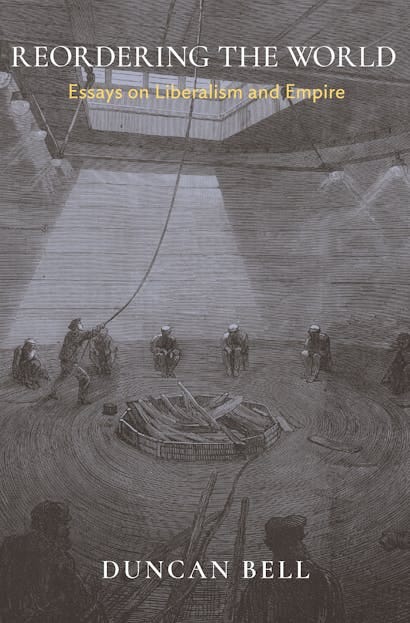
Duncan Bell, Reordering the World: Essays on Liberalism and Empire, (2016)
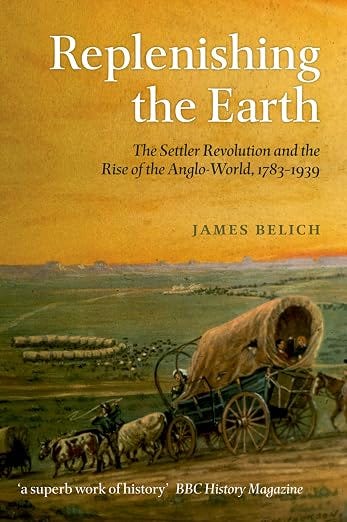
James Belich, Replenishing the Earth - The Settler Revolution and the Rise of the Anglo World, 1789-1930, (2009)
In his very good podcast, Joe Walker asked the historian Niall Ferguson if there was one big idea of his that he would he want to be remembered for. ‘If there’s one’, Ferguson replied, ‘it’s that history is the history of empires. You can pretend it’s nation states, but that’s really just a short period of time. It’s mostly empires.’
That’s not a bad place to start with modern Australia.
When the Australian colonies federated in 1901, they did so in part to consolidate the British Empire, not to break away from it. This has posed something of a conundrum in the elusive search of an ‘Australian identity’. In one influential article, the historian Neville Meaney rejected the teleological story of Australia’s long march to independent nationalism. Hold up, he said; take a look at what Australian decision makers were actually saying in the nineteenth and early twentieth centuries. They wanted more empire, not less; but what they demanded, in turn, was some control over how their interests would be protected in an imperial superstructure.
John Darwin’s Empire Project conceptualises the British empire as a multi-faceted, decentralised global system that used a range of tools, from classic military coercion, to migration, finance, and even a flexible liberalism, to secure British interests while, in settler colonies like Australia, building a very potent ‘community of culture’, as Meaney might have described it. Duncan Bell’s Re-ordering the World: Essays on Liberalism and Empire reminds us that this system was being consolidated just as liberalism became the dominating political ideal of the English speaking world. How did political thinkers reconcile the two? Bell helps us understand the generation of Henry Parkes and, later, Alfred Deakin, believed liberalism was best secured through empire than independent nationalism (arguments that continue to this day in the Anglosphere).
Belich’s Replenishing the Earth notes that the number of English speaking people grew from about 12 million in 1790 to 200 million by 1930, “a far greater rate than Indian or Chinese growth, as well as Russian and Hispanic”. He calls this the Anglo settler revolution, a phenomenon he rates as important as the Industrial Revolution in terms of how it shaped the world politically. The Anglo world, spread across Britain, the United States, Canada, Australia, New Zealand, South Africa, and other pockets of the globe, was larger than the British Empire, but densely integrated in commerce, culture, technology, and political ideas. This is transitional history at its finest, and, in my view, a more grounded account of what is sometimes called ‘settler colonialism’. But this is not the ideologically-driven Patrick Wolfe version. Racial identity and conflict are there, but it is not the skeleton key to understanding the nineteenth century. Rather, it is the confluence of the Industrial Revolution, mass migration, finance, what Belich calls the settler ‘boom mentality’ (what Keynes would ascribe to ‘animal spirits’), and political ideas. This history offers a way to rethink nineteenth century Australia, away from the ‘British outpost’ story towards something more global.
Most Dark Emu book about Australia
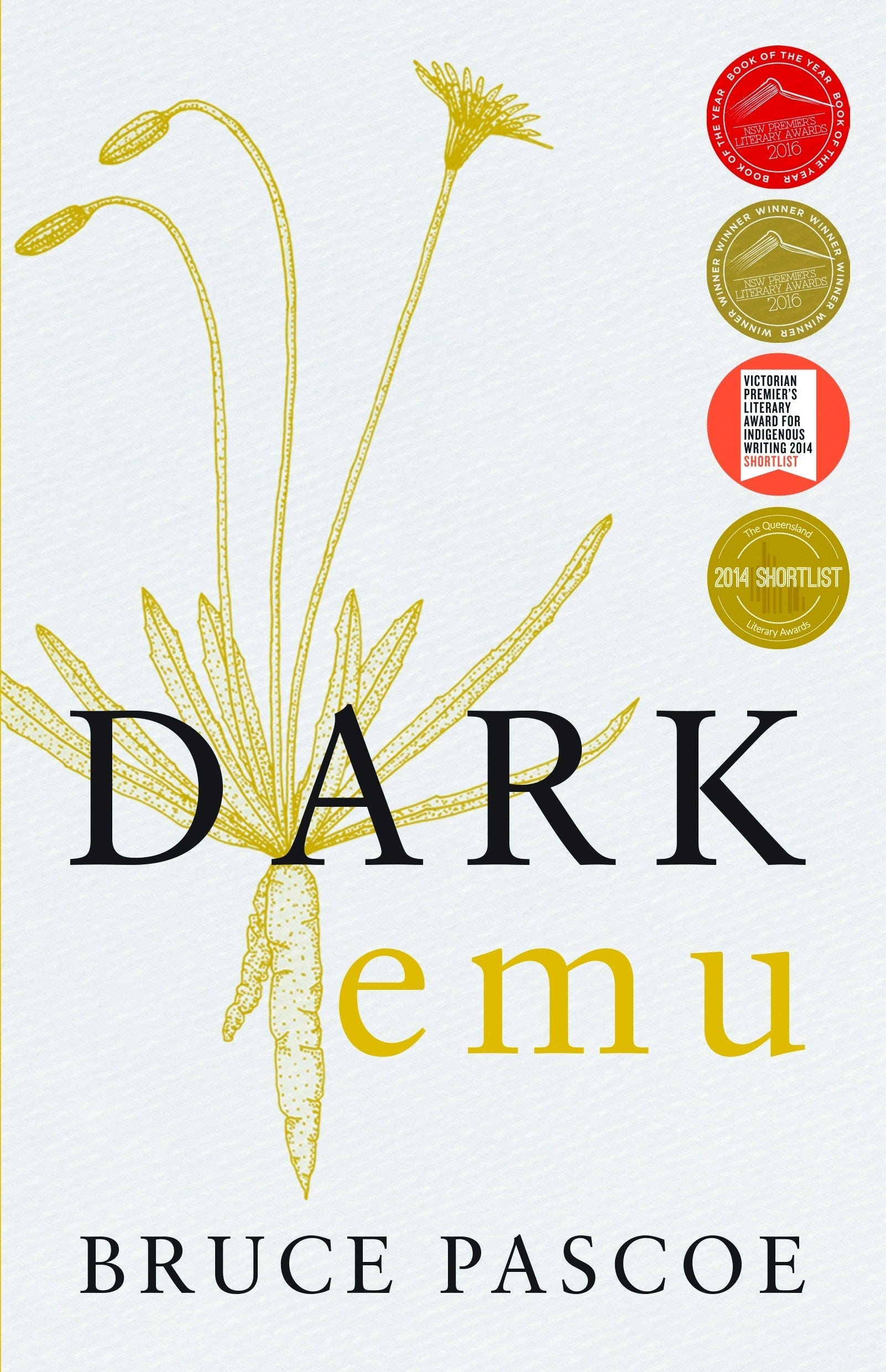
Dark emu, by Bruce Pascoe
This is probably the best-selling book of Australian history in the 21st century, so it’s worth saying a few words about it.
This is about pre-colonial Australia and how humans managed the land, sometimes in ways that resemble agricultural and aquacultural practices. Pascoe is a very good writer, simple and elegant, and he provides a number of examples for the reader who will be surprised by how far pre-1788 Australia strayed from hunter gatherer stereotypes. For instance, in how certain native grains were harvested and stored.
This became a controversial book. Some anthropologists did not like the comparison of indigenous practices with western practices, for it implied a civilisational hierarchy that does not exist. Other historians argue that Pascoe misread or misstated certain primary sources, mostly from colonial memoirs or documents. These critiques are valid
Do we say farmers or hunter gatherers? Or maybe something else? In the end, that’s a debate about labels; not unimportant, but not really a historical question. I thought this paper lays out the debate quite well. In the end it’s the action that counts. The strongest material in Dark Emu was common knowledge to archeologists and historians, but not the typical reader, who will finish the book with a greater appreciation of pre-1788 Australia. That itself is not too far removed from the first chapter of John Hirst’s Australian History in 7 Questions, ‘Why did Aboriginal people not become farmers?’ In fact, Hirst and Pascoe describe much of the same thing. It is the labels that are in dispute. As with so much of history, the controversy comes from how we interpret the past in light of the concerns of the present.
The ‘neoliberal’ revolution in Australia
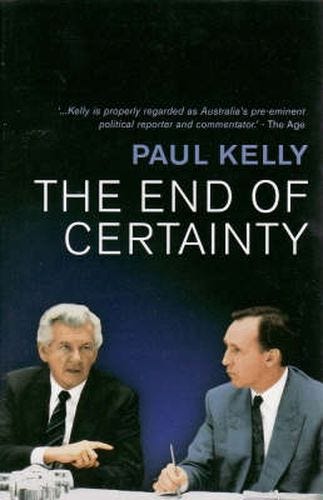
Paul Kelly, The End of Certainty: Power, Politics, and Business in Australia, (1994)

Alf Rattigan, Industry Assistance: The Inside Story, (1986)

Warner Max Corden, Lucky Boy in the Lucky Country, (2018)
I’ve never really liked the term ‘neoliberalism’, which, like many abstract nouns deployed in political discussion, is far too loaded with judgment to be a trustworthy concept for analysis.
Still, people use it because it seems to capture a period of history that very broadly fits a pattern: the breakdown of the post-war Keynesian consensus followed by a new paradigm favoured by a large enough section of the policy elite that recommended deregulation, privatisation, free trade, smaller government, lower taxes, etc. Undoubtedly this reflects part of the Australian experience.
Paul Kelly’s The End of Certainty is the best narrative history of this moment, beginning with the election of Hawke Labor Government, and finishing in the early 1990s. Kelly describes the breakdown of what he calls the ‘Australian Settlement’ of 1901: high tariffs, compulsory wage arbitration, ‘state socialism’, White Australia, and imperial benevolence. This policy compact lasted until the second half of the twentieth century when, by the 1980s, it collapsed. The uniqueness of the ‘Australasian’ experience, which includes New Zealand, is that it was Labo[u]r governments that pushed reform. This makes it less a story of ideology and more about something explicitly structural, and how the technocrats of the day attempted to respond to a fast changing global economy. On the Labor side, Kelly frames this as a debate between the ‘international rationalists’ and the ‘sentimentalist traditionalists’.
I think of this period as an epistemic revolution as much as a ‘free market’ ideological one - Cold War politics tended hammer everything into a neat left vs right framework; but there is another story centred by the rise of the professionalised society in the 20th century, and a change in what increasingly counted as authoritative knowledge. In the case of economic policy, this is a story of the rise of professional economists.
Alf Rattigan, who became chair of the Tariff Board in 1963 - when the protectionist creed was infallible - implicitly offers this alternative account in his memoir Industry Assistance. Rattigan never had an ideological conversion, but he witnessed first hand, and aided, a bureaucratic revolution in his own institution. In 1963, the Tariff Board was, in his words, ‘an ad hoc operator’, tending to make its recommendations on tariff protection based on the narrow demands of Australian manufactures on a product by product basis. By the end of his tenure, the Tariff Board was a professional and specialised outfit, incorporating new data sources and tools of analysis (like measuring ‘effective protection’) “developed by some academics in the early 1950s”. In 1974, the Tariff Board becomes the Industry Assistance Commission, headed by Rattigan, who declares it cannot fulfil its obligations without ‘a comprehensive analytical framework and an integrated data base’. Here begins the modern Age of Evidence Based Policy Making. The Industry Assistance Commission would of course evolve over time to eventually become the Productivity Commission.
Where were these new tools of analysis coming from? One of the most important figures is Max Corden, the great international trade economist whose family left Nazi Germany in 1939 when he was 12. His autobiography, Lucky Boy in a Lucky Country, is a concise but revealing glimpse into post-war intellectual Australia. Corden is not the first generation of economist-as-policy-advisor, but he is part of an expanding professional and international cohort who studied overseas, were increasingly connected to international professional networks, and were innovative in using modern economic theory to redescribe old policy problems in a new analytical language. Corden helped popularise the concept of ‘effective protection’, which provided, really for the first time, a systematic way of measuring the true level of tariff protection and its cost to the wider community.
Here is Corden himself:
Here is a final question about my role on policy: What was my underlying philosophy or motivation affecting my writing on tariff policy in the 1960s?
Was I a “neoliberal” or—even worse—“a market fundamentalist”? The brief answer is “no”. Rather, as a student I fell under the influence of Arthur Pigou’s The Economics of Welfare. This book showed how externalities should be dealt with in the presence of market failure using appropriate taxes and subsidies.
I was not opposed to the principle of government intervention. There is surely an important role for governments. But intervention needs to be rational and in the national interest. That is indeed a “liberal” way of thinking, but not what the enemies of so-called neoliberalism have in mind.
This kind of post is exactly why I subscribe.
An enlightening and useful list of books as well as providing an illuminating background for current policy debates.